
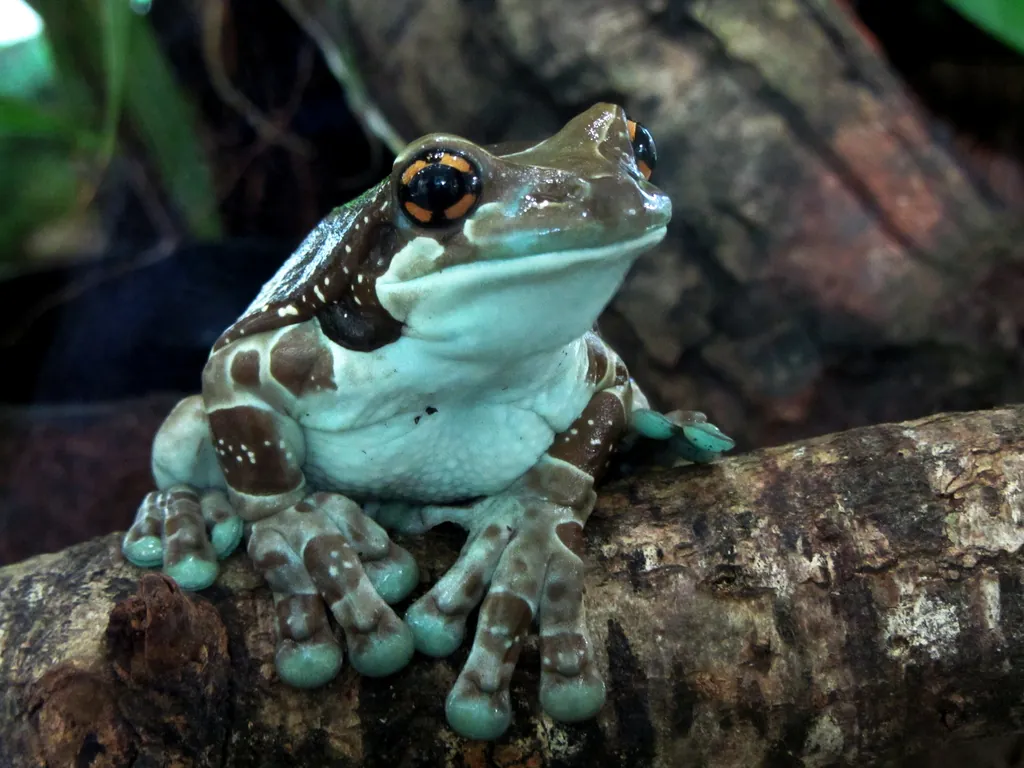
Amazon Milk Frog
Trachycephalus resinifictrix
A large, arboreal Amazonian tree frog with bluish-gray and brown banding, pale blue toe pads, and a sticky milky defensive secretion. It is a display amphibian that needs a tall, humid, well-ventilated enclosure, clean water, and live insects rather than routine handling.
Overview
The Amazon milk frog (Trachycephalus resinifictrix, formerly Hyla resinifictrix and Phrynohyas resinifictrix) is a large canopy hylid from eastern Amazonia and the Guianas. It is nocturnal and arboreal, breeding exclusively in water-filled tree holes. Captive-bred animals are widely available and generally hardy, but they need a tall enclosure, humidity with real airflow, clean dechlorinated water, live insects with calcium support, and very little handling. When threatened they can release a sticky white skin secretion that may irritate eyes, mouth, or broken skin.
Native Regions
Eastern Amazon Basin (Brazil), Guyana, Suriname, French Guiana
Habitats
Tropical primary rainforest canopy, Terra-firme rainforest, Water-filled tree holes (phytotelmata)
Adult Length
Males about 2.5-3 inches (6.5-7.7 cm); females about 3.4-4 inches (8.6-10 cm)
Adult Weight
Adult weight is poorly published; captive frogs about 5-6 cm have been recorded at roughly 7-19 grams, and large adult females are heavier. A commonly repeated 4-5 gram zoo figure is inconsistent with adult size.
Lifespan
8–15 years
For Beginners
Possible for a careful first amphibian only if the keeper is ready for live insects, daily water hygiene, misting with ventilation, and almost no handling. Humidity mistakes, dirty water, and overheating are the usual failures. Intermediate is a fair label because the species is messy, vocal, and skin-sensitive.
For Experienced Keepers
Experienced keepers can refine tall bioactive or paludarium setups, low-level UVB with shade, supervised same-species groups, quarantine and disease testing, and seasonal breeding. A single clutch can produce hundreds of tadpoles, so breeding should be intentional.
Key Points
- › A large nocturnal tree frog kept mainly as a display animal
- › Needs a tall, humid, ventilated setup with clean water and climbing structure
- › Captive-bred and commonly available, but not a high-contact pet
Appearance & Behavior
Adults are plump arboreal frogs about 2.5-4 inches (6.5-10 cm) long. Males are typically 2.5-3 inches (about 65-77 mm); females are larger, often about 3.4-4 inches (86-100 mm). The dorsum is bluish-gray to gray-brown with darker brown bands, cream-edged limb bars, and large toe pads that are often pale blue. The iris is golden with a dark Maltese-cross pupil. Juveniles are more contrastingly banded; older frogs, especially males, develop more glandular, bumpy skin. Males have paired lateral vocal sacs and seasonal nuptial pads.
Normal Behavior
These frogs are nocturnal and crepuscular. They usually rest on branches, cork, or in cavities by day with limbs tucked and eyes closed, then climb and hunt at night. Males may call loudly from water-filled cavities, especially after rain or at dusk and dawn. They are often visible display frogs when comfortable.
Social Behavior
Same-species groups can work when frogs are similar in size, the enclosure is tall and furnished with multiple perches, tubes, and feeding stations, and each animal is seen eating. House alone if there is bullying, large size disparity, weight loss, or insufficient space. Adult males can call loudly at night.
Warning Signs
Persistent lethargy, prolonged appetite loss, dry or damaged skin, weak grip on glass, constant soaking, bloating, redness of the underside or limbs, abnormal shedding, open-mouth breathing, or sudden weight change warrant husbandry review and veterinary advice.
Key Points
- › Bluish-gray and brown-banded canopy frog with blue toe pads and a golden crossed iris
- › Nocturnal; often rests in view by day and becomes active at night
- › Can be kept singly or in carefully monitored same-species groups
Enclosure & Environment
Enclosure Size
Minimum about 18 x 18 x 24 inches (45 x 45 x 60 cm) for one adult or a pair; use a larger tall enclosure for groups. Zoo breeding setups have used about 24 x 18 x 36 inches for a pair. Vertical climbing space is essential; the previous 15-inch-high catalogue size is too short.
Enclosure Type
Tall front-opening glass or similarly nonporous terrarium with a secure lid and screened ventilation. A paludarium can work if frogs can leave the water easily; this is not an aquarium species.
Substrate
Use a moisture-retentive mix such as coconut fiber, cypress mulch, or a bioactive soil mix over drainage, often topped with sphagnum or leaf litter. Keep drainage water inaccessible. Avoid fine gravel that can be swallowed and aromatic woods. Paper towel is better for quarantine because feces and skin are easier to inspect.
Heating
Maintain daytime ambient temperatures around 75-80°F with a mild elevated warm area of about 82-85°F. Allow nights near 68-75°F. Use thermostatically controlled low-wattage heat and never use hot rocks. Amphibians tolerate cool better than heat; avoid sustained temperatures above about 86°F.
Humidity
Keep average humidity about 60-80%, with brief rises after misting and enough airflow that surfaces can partly dry. Constant saturation with poor ventilation increases bacterial skin risk; a fully dry enclosure causes dehydration. Mist once or twice daily with dechlorinated water and watch skin and shedding rather than chasing one number.
Lighting
Provide a roughly 12-hour day and night cycle. Low-output UVB is recommended because daily UVB improved juvenile growth and skeletal development in a controlled study of this species. Treat the setup as a low Ferguson-zone gradient with dense shaded retreats, mount UVB above mesh rather than through glass, and replace bulbs on schedule. Plant lights must not overheat resting branches.
Décor & Enrichment
Offer thick, stable branches, cork flats or tubes, live or sturdy artificial plants with broad leaves, and elevated hides. Include a large, shallow, easily entered dish of dechlorinated water changed daily. An elevated water-holding cork tube can mimic a tree hole without forcing the frog to sit in dirty water.
Cleaning & Maintenance
Spot-clean feces and uneaten insects daily. Change the water dish daily; this species often defecates in water. Deep-clean periodically with an amphibian-safe disinfectant and rinse thoroughly. Separate tools from other amphibian enclosures.
Key Points
- › Use a tall, secure enclosure of at least 18 x 18 x 24 inches with climbing structure
- › Pair humidity with ventilation and a mild warm gradient, not a sealed wet box
- › Provide clean dechlorinated water and shaded low-level UVB
Diet & Nutrition
An insectivorous frog that needs varied, gut-loaded live prey. Adults gain weight easily, so feeding should be measured rather than unlimited.
Food Types
Staples include gut-loaded crickets, roaches, and locusts where legal. Secondary options include flies, silkworms, hornworms, small earthworms, and black soldier fly larvae. Reserve high-fat waxworms and hard mealworms as occasional treats. Wild diet also includes other small invertebrates; do not offer vertebrates as a routine captive staple.
Feeding Schedule
Feed juveniles daily. Feed adults two or three measured meals per week, adjusting to body condition. Remove uneaten insects within a few hours so they cannot bite resting frogs. Feed in the evening when the frogs are active.
Supplements
Dust juveniles more frequently with calcium and provide a weekly amphibian-safe multivitamin that includes vitamin A. For adults, dust calcium about two to three times weekly and multivitamin about weekly. Match D3 dusting to the UVB plan; stacking several D3-fortified products can cause overdosing.
Hydration
Maintain a large, shallow dish of clean dechlorinated or otherwise conditioned water and mist with the same quality water. Do not rely on untreated chlorinated tap water. Change bowl water daily.
Preparation
Offer prey no wider than the space between the frog's eyes. Gut-load insects for about 24-48 hours and dust immediately before feeding.
Common Mistakes
Overfeeding adults, unvaried cricket-only diets, oversized prey, skipping gut-loading or supplements, leaving insects in overnight, and using dirty or chlorinated water.
Key Points
- › Feed a varied rotation of gut-loaded insects
- › Juveniles daily; adults two to three times weekly
- › Obesity and calcium imbalance are common husbandry failures
Handling
This is an observation frog. Permeable skin, a sticky defensive secretion, and strong jumping make routine handling a risk rather than enrichment.
Techniques
Move the frog with a clean, ventilated cup whenever possible. If contact is necessary, wash and rinse hands thoroughly or wear powder-free gloves moistened with dechlorinated water, support the body briefly, and keep the session short.
Do's & Don'ts
Do not handle with dry, soapy, lotioned, or chemically contaminated hands. Avoid frequent handling, chasing, or squeezing. Keep secretion away from eyes, mouth, and open wounds, and wash after any contact. Do not treat the milky secretion as harmless because it is not medically significant venom; it can still irritate tissues.
Taming
Acclimation comes from predictable care, not from handling practice. Many keepers enjoy this species mainly as a nocturnal display frog.
Stress Signals
Stop if the frog struggles repeatedly, jumps wildly, secretes white mucus, becomes unusually pale or dark, refuses to settle, or shows abnormal breathing.
Key Points
- › Not a handling pet; use a cup for necessary moves
- › Protect permeable skin from soaps, lotions, and dry hands
- › The milky secretion can irritate eyes and broken skin
Health & Wellness
Common Health Issues
Bacterial skin disease and red-leg syndrome
Description
Opportunistic bacterial disease is associated with dirty water, stagnant humidity, poor ventilation, and other stressors. Reddened skin is a warning sign, not a home diagnosis.
Symptoms
Redness of limbs or underside, sores, lethargy, appetite loss, weak grip, or abnormal posture.
Prevention
Change water daily, allow partial drying between mistings, keep temperatures in range, and quarantine new amphibians with separate tools.
Treatment
Isolate as advised and contact a qualified exotic or amphibian veterinarian promptly; do not apply over-the-counter skin treatments.
Metabolic bone disease and nutritional imbalance
Description
Inadequate calcium, vitamin D3, UVB access, or prey quality can impair skeletal development. Daily UVB improved growth and skeletal measures in juvenile Amazon milk frogs compared with no UVB.
Symptoms
Weakness, poor posture or grip, tremors, deformities, declining appetite, or abnormal limb use.
Prevention
Gut-load feeders, use measured calcium and multivitamin dusting, and provide low-level UVB with shaded retreats.
Treatment
Seek veterinary diagnosis; do not attempt high-dose vitamin, calcium, or UVB correction without professional direction.
Dehydration and humidity-related skin problems
Description
Humidity that is too low dries permeable skin, while constant saturation with poor airflow encourages infection. This species needs humid air and clean water, not a sealed wet box.
Symptoms
Dry or sticky skin, lethargy, clinging to water dishes, abnormal shedding, or skin lesions.
Prevention
Keep average humidity about 60-80%, mist with dechlorinated water, allow partial drying, and always provide a clean soaking dish.
Treatment
Correct husbandry immediately and contact a qualified exotic or amphibian veterinarian if the frog does not improve or shows lesions.
Obesity
Description
Adults readily overeat in captivity when feeding frequency or prey volume is too high for their nocturnal activity pattern.
Symptoms
Excess bulk, reduced climbing, sluggishness, and difficulty keeping a healthy body outline.
Prevention
Use an age-appropriate feeding schedule, varied prey, climbing opportunities, and regular body-condition checks.
Treatment
Contact a qualified exotic or amphibian veterinarian before making aggressive diet changes; supportive husbandry adjustments should follow veterinary guidance.
Infectious amphibian diseases including chytridiomycosis
Description
Amphibians can carry chytrid fungus (Batrachochytrium dendrobatidis), ranavirus, and other pathogens that threaten collections and wild populations. Educational awareness is not a diagnosis.
Symptoms
Lethargy, abnormal shedding, redness, appetite loss, bloating, incoordination, or sudden death, especially in newly acquired or recently metamorphosed frogs.
Prevention
Quarantine newcomers for at least 6-8 weeks, use separate tools, ask an amphibian-experienced veterinarian about fecal exams and Bd or ranavirus testing, and never release captive frogs.
Treatment
Contact a qualified exotic or amphibian veterinarian for testing and prescribed treatment; do not medicate the enclosure or raise heat blindly.
Preventative Care
Monitor appetite, weight or body condition, grip, temperature, humidity, and water cleanliness. Quarantine new amphibians, use separate tools, minimize handling, and schedule wellness review with an exotic veterinarian experienced with amphibians.
Emergency Signs — seek vet care immediately
Seek prompt amphibian-experienced veterinary care for open-mouth breathing, severe lethargy, inability to climb or right itself, marked bloating, bleeding, extensive redness or skin damage, eye or mouth irritation after secretion exposure, or prolonged refusal to eat.
Key Points
- › Dirty water, stagnant humidity, and calcium errors cause many problems
- › Quarantine and veterinary testing reduce infectious-disease risk
- › Illness signs need veterinary diagnosis, not home medication
Breeding
In the wild, breeding is tied to rainy-season tree holes 2-32 m above ground. Captive frogs may breed whenever they are well fed and given standing water, but a rest period followed by warmer, wetter conditions produces more controlled results.
Preparation
Breed only healthy, mature frogs with a plan for hundreds of tadpoles, quarantine biosecurity, and rearing space. Confirm local legality. Provide a clean water-filled cavity or large dish; a cork tube standing in a water dish is a practical tree-hole mimic. A cooler, slightly drier rest of about 5-6 weeks is often used before increasing photoperiod, temperature, and misting.
Breeding Process
Males call from water-filled cavities and may physically defend them. Axillary amplexus occurs in the water. Females deposit a floating gelatinous mass that often adheres to the cavity wall. Clutches commonly contain about 100-1,540 eggs; some reports reach about 2,000-3,000. Remove eggs from adults because tadpoles opportunistically eat later clutches.
Egg Care
Hatching usually occurs in 24-48 hours. Keep eggs and tadpoles in clean, dechlorinated, low-mineral water around 73-78°F with gentle filtration or frequent water changes. Wild tadpoles eat detritus and conspecific eggs; captive tadpoles do well on finely crushed fish food and do not require eggs.
Hatchling Care
Metamorphosis commonly occurs in 6-10 weeks, with some larvae taking longer. Froglets are about 0.4-0.6 inches (1-1.5 cm), poor swimmers, and fragile. Use shallow water they can leave easily, tiny live prey such as fruit flies and pinhead crickets, high humidity with cleanliness, and minimal handling. Stress and bloating after metamorphosis are documented husbandry risks.
Key Points
- › Tree-hole breeders that can produce very large clutches
- › Eggs usually hatch within two days; tadpoles metamorphose in about 6-10 weeks
- › Do not breed without a complete larval-rearing plan