
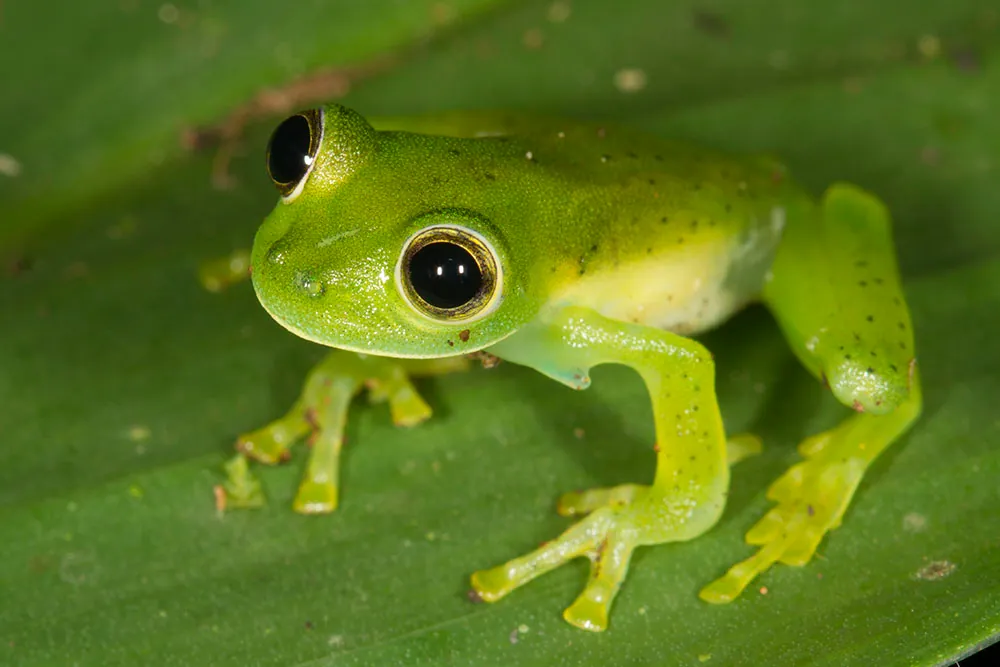
Emerald Glass Frog
Espadarana prosoblepon
A tiny nocturnal streamside glass frog with lime-green skin, green bones, and a partly translucent belly. It is a specialist display amphibian that needs a tall, very humid, well-ventilated enclosure with moving water, tiny live insects, and no routine handling.
Overview
The emerald glass frog (Espadarana prosoblepon, formerly Centrolene prosoblepon) is a tiny nocturnal centrolenid from humid forests of Honduras to Ecuador. It lives in streamside vegetation, where males call from leaves overhanging running water. The lime-green dorsum, green bones, and partly translucent venter make internal organs visible, but this is a specialist amphibian, not a novelty pet. Captive care needs a tall planted enclosure, very high humidity with real airflow, shallow moving water, tiny live insects, and almost no handling. Thin skin dries quickly and is easily damaged by soaps, lotions, or dirty water.
Native Regions
Eastern Honduras, Nicaragua, Costa Rica, Panama, Pacific and Andean Colombia, Pacific Ecuador
Habitats
Humid lowland rainforest, Premontane and lower montane wet forest, Dense vegetation along fast-moving streams
Adult Length
Males about 0.8-1.1 inches (21-28 mm); females about 0.8-1.2 inches (20-31 mm) snout-vent length
Adult Weight
Adults typically about 0.6-1.1 grams (about 0.02-0.04 ounces); females are heavier after feeding or before laying eggs
Lifespan
4–8 years
For Beginners
Not a first frog. Fruit-fly cultures, daily misting with ventilation, water quality, and the risk of desiccation or stagnant-air infection make this a poor beginner species. Choose a hardier display amphibian first.
For Experienced Keepers
Experienced keepers can maintain a tall paludarium with broad-leaved plants over a shallow stream, low-level UVB with dense shade, quarantine and disease testing, and intentional breeding. Larvae are benthic and slow to metamorphose, often taking six to ten months, so breeding should be planned.
Key Points
- › A tiny nocturnal streamside display frog, not a handling pet
- › Needs a tall, very humid, ventilated setup with plants, leaf perches, and clean moving water
- › Advanced because of size, humidity-airflow balance, tiny prey, and delicate skin
Appearance & Behavior
Adults are small even among glass frogs: males about 21-28 mm (0.8-1.1 inches) snout-vent length and typically 0.6-0.8 g; females about 20-31 mm (0.8-1.2 inches) and typically 0.7-1.1 g. The dorsum is lime to darker green and may have dark or yellow spots. Eyes are large and set at about 45 degrees, giving binocular vision. Bones are green and visible through the skin. The belly is partly translucent; intestines are often screened by a white peritoneal sheath, while the heart and other organs may still show. Males have a pronounced humeral spine used in combat; females have a smaller hook. Finger discs are large, and there is webbing between the outer fingers.
Normal Behavior
These frogs are strictly nocturnal and arboreal. By day they rest on leaves or in vegetation near streams and are hard to see. At night they climb, hunt small arthropods, and, in season, males call a high-pitched three-note 'chee-chee-chee' from leaves over water. They may also feed during daytime rain. Adults are sedentary territory users rather than wide-ranging wanderers.
Social Behavior
Males are territorial and can grapple using humeral spines, dangling from leaves during combat. Routine group housing is not recommended. A pair or a female-biased group can work only in a much larger tall enclosure with many leaf territories, and only if each frog is seen eating and no injuries appear. House singly if space is limited or males fight.
Warning Signs
Persistent lethargy, dry or damaged skin, loss of grip, remaining flattened on glass, bloating, redness of the underside or thighs, cloudy or retained shed, gaping, or a sunken look through the translucent venter warrant husbandry review and veterinary advice. Loss of ventral translucency is not by itself a reliable illness sign.
Key Points
- › A tiny lime-green glass frog with green bones and a partly see-through belly
- › Nocturnal and streamside; males call and defend leaf territories
- › Best kept singly or as a carefully monitored pair, not as a crowded group
Enclosure & Environment
Enclosure Size
Minimum about 18 x 18 x 24 inches (45 x 45 x 60 cm) for one adult or a pair. Atlanta Botanical Garden used no smaller than a 20-gallon high for a pair or group; Brian Kubicki used about 14 x 12 x 30 inches of leaf space for up to five frogs. The previous 30 x 15 x 15 inch catalogue size was too short for an arboreal frog. Larger height is better than extra floor area.
Enclosure Type
Tall front-opening glass or similarly nonporous terrarium with a secure lid and screened ventilation. A paludarium with a 2-4 cm (about 1-1.5 inch) stream is closer to wild habitat than a dry tank with a bowl. This is not an aquarium species.
Substrate
Use a moisture-retentive, amphibian-safe mix such as coconut fiber, leaf litter, and moss over drainage, or a false bottom under a shallow stream. Keep standing water very shallow with haul-outs. Avoid fine gravel that can be swallowed, cedar or pine, and chemical soils. Paper towel is acceptable for quarantine.
Heating
Keep daytime ambient temperatures about 70-78°F. A mild elevated warm leaf zone of about 75-78°F is enough; these frogs do not need a hot basking lamp. Allow a 5-10°F night drop, typically about 62-70°F. Use a thermostat and measure at frog level. Localized heat and temperatures much above the upper 70s°F risk rapid desiccation. Amphibians tolerate cool better than heat.
Humidity
Keep humidity very high, about 70-90%, with brief peaks after misting. Multiple daily mistings or an automated mister help, but stagnant saturated air encourages bacterial and fungal skin disease. The enclosure should smell humid and fresh, not sour. Pair humidity with real airflow.
Lighting
Provide a roughly 12-hour day and night cycle with plant-safe fluorescent or LED lighting. Low-output UVB is recommended as part of the care plan even though the species is nocturnal; supply dense shaded leaf retreats, mount UVB above mesh rather than through glass, and replace bulbs on schedule. Do not use bright white light at night. Heat-producing spots must not dry or overheat resting leaves.
Décor & Enrichment
Offer many smooth broad leaves (for example philodendron, anthurium, or similar), fine climbing stems, and cover plants. Most leaves should overhang water if breeding is possible. Include rocks or planted banks so frogs can leave the water. A gentle current or drip is useful; a deep pool is a drowning risk.
Cleaning & Maintenance
Spot-clean feces and uneaten insects daily. Refresh or filter the water often; glass frogs and their larvae are sensitive to poor water. Deep-clean periodically with an amphibian-safe disinfectant or diluted bleach, then rinse thoroughly with dechlorinated water. Use separate tools from other amphibian enclosures.
Key Points
- › Use a tall, planted enclosure of at least 18 x 18 x 24 inches with leaves over shallow water
- › Keep humidity very high while providing real ventilation
- › Avoid short tanks, hot basking lamps, and stagnant wet boxes
Diet & Nutrition
An insectivore that hunts small arthropods at night. Captive frogs do well on tiny flying insects; variety and calcium support matter because the frogs are too small for most standard feeders.
Food Types
Staples are fruit flies (Drosophila melanogaster, then D. hydei) and gut-loaded pinhead to about 1/8-inch crickets. Larger adults may take small houseflies. Springtails help froglets. Soft-bodied tiny arthropods can add variety. Do not offer wild-caught insects, rodents, or produce. Hard or oversized prey can injure a 1-inch frog.
Feeding Schedule
Atlanta Botanical Garden fed metamorphs every other day. Juveniles generally need nightly or daily access to tiny flies. Adults can take small meals every one to two nights; specialist keepers keep a trickle of fruit flies available during evening activity. Remove leftover crickets so they cannot bite resting frogs.
Supplements
Dust most meals for froglets and juveniles with calcium, using D3 according to the UVB plan. Adults can be dusted about every other feeding. Give an amphibian-safe multivitamin that includes vitamin A about weekly. Do not stack multiple D3 products.
Hydration
Mist with dechlorinated, reverse-osmosis, or rain water and keep a shallow, easily exited water film or stream. Frogs absorb moisture through the skin and from wet leaves. Do not use untreated chlorinated tap water, distilled water alone, or soaps in the enclosure.
Preparation
Offer prey no wider than the frog's head. Gut-load crickets and flies when possible and dust immediately before feeding. A fruit-fly culture with a small emergence hole can provide a continuous night-time supply. Do not dump large numbers of flies onto a newly metamorphosed froglet.
Common Mistakes
Prey that is too large, cricket-only diets, skipping calcium, leaving insects in overnight, letting humidity crash, and using chlorinated or stagnant water.
Key Points
- › Feed tiny live insects, especially fruit flies and pinhead crickets
- › Froglets every other day; juveniles nightly; adults every 1-2 nights
- › Calcium, vitamin A, and prey size matter more than volume
Handling
This is an observation frog. The skin is thin, permeable, and easily torn. Routine handling is not appropriate.
Techniques
Move the frog with a clean, moistened, ventilated cup or by relocating the leaf it is sitting on. If contact is unavoidable, wash and rinse hands thoroughly or wear powder-free gloves moistened with dechlorinated water, support the body for seconds only, and keep the frog over a soft landing.
Do's & Don'ts
Do not handle with dry, soapy, lotioned, or chemically contaminated hands. Do not grab, chase, or pass the frog around. Do not house it as a children's handling pet. Skin secretions are not medically significant venom, but amphibian skin is easily damaged and can carry pathogens; wash after any contact.
Taming
Acclimation comes from predictable night-time feeding and an undisturbed leaf rest, not from handling practice. These frogs do not become handling pets.
Stress Signals
Stop if the frog leaps repeatedly, becomes unusually pale or dark, remains flattened and motionless, loses grip, or shows abnormal breathing.
Key Points
- › Not a handling pet; move with a cup or the leaf it is on
- › Protect thin, permeable skin from soaps, lotions, and dry hands
- › Stress and desiccation from handling are common failures
Health & Wellness
Common Health Issues
Dehydration and humidity crashes
Description
Thin skin loses water quickly. Dry air, strong ventilation without misting, or hot spots can desiccate a glass frog in hours.
Symptoms
Sticky or dull skin, lethargy, sunken look through the venter, clinging to remaining wet surfaces, or sudden death after a dry period.
Prevention
Keep humidity about 70-90%, mist several times daily with dechlorinated water, and avoid localized heat that dries leaves.
Treatment
Restore humidity and a shallow clean water film immediately and contact a qualified exotic or amphibian veterinarian if the frog does not recover promptly.
Bacterial skin disease and red-leg syndrome
Description
Opportunistic gram-negative infection is associated with stagnant humidity, dirty water, poor ventilation, crowding, and other stressors. Ventral redness is a warning sign, not a home diagnosis.
Symptoms
Redness of thighs, legs, or underside, sores, lethargy, appetite loss, or weak grip.
Prevention
Provide airflow with high humidity, keep water shallow and clean, avoid overcrowding, and quarantine new amphibians with separate tools.
Treatment
Isolate as advised and contact a qualified exotic or amphibian veterinarian promptly; do not apply over-the-counter skin treatments.
Metabolic bone disease and nutritional imbalance
Description
Inadequate calcium, vitamin D3, UVB access, or prey quality can impair skeletal development in tiny, fast-growing froglets. Hypovitaminosis A is a documented captive-amphibian risk.
Symptoms
Weakness, poor posture or grip, tremors, deformities, or declining appetite.
Prevention
Gut-load and dust tiny prey, provide low-level UVB with shaded leaves, and include a vitamin A source.
Treatment
Seek veterinary diagnosis; do not attempt high-dose vitamin, calcium, or UVB correction without professional direction.
Parasites, especially lungworm
Description
Atlanta Botanical Garden reported Rhabdias and other nematodes as common veterinary concerns in glass frogs. Wild-caught animals are higher risk.
Symptoms
Weight loss despite eating, lethargy, abnormal stools, or respiratory effort. Many infections are found only on fecal exam.
Prevention
Quarantine newcomers, request fecal testing, keep enclosures clean, and prefer captive-bred frogs.
Treatment
Have an amphibian-experienced veterinarian diagnose and prescribe treatment; do not give dewormers without guidance.
Infectious amphibian diseases including chytridiomycosis
Description
Batrachochytrium dendrobatidis caused large wild declines in this species in parts of Costa Rica and Panama. Captive collections can also carry chytrid, ranavirus, and other pathogens. Educational awareness is not a diagnosis.
Symptoms
Lethargy, abnormal shedding, redness, appetite loss, incoordination, or sudden death, especially in newly acquired frogs.
Prevention
Quarantine newcomers for at least 6-8 weeks, use separate tools, ask an amphibian-experienced veterinarian about fecal exams and Bd testing, and never release captive frogs.
Treatment
Contact a qualified exotic or amphibian veterinarian for testing and prescribed treatment; do not medicate the enclosure or raise heat blindly.
Preventative Care
Monitor appetite, body condition through the venter, grip, temperature, humidity, and water cleanliness. Quarantine new amphibians, use separate tools, minimize handling, prefer captive-bred animals, and schedule wellness review with an exotic veterinarian experienced with amphibians.
Emergency Signs — seek vet care immediately
Seek prompt amphibian-experienced veterinary care for severe lethargy, inability to grip or right itself, marked bloating, bleeding, extensive redness or skin damage, open-mouth breathing, or prolonged refusal to eat.
Key Points
- › Humidity crashes, stagnant wet air, and tiny-prey nutrition errors cause many problems
- › Quarantine and veterinary testing reduce chytrid and parasite risk
- › Illness signs need veterinary diagnosis, not home medication
Breeding
In the wild, breeding is tied to humid nights and the rainy season, often about May through September. Males call from streamside leaves. Captive breeding is most likely in a tall planted paludarium with moving water, heavy misting or rain simulation, and plenty of food for females.
Preparation
Breed only healthy, mature frogs with a plan for months of tadpole care, quarantine biosecurity, and rearing space. Prefer captive-bred stock. Limit adult males; they defend calling sites. Do not breed wild-caught animals without veterinary screening for chytrid and parasites.
Breeding Process
The female approaches a calling male, amplexus lasts a few hours, and eggs are laid in a single-layer jelly mass on the upper surface of a leaf, mossy rock, or, in captivity, glass overhanging water. Clutches for this species are often about 20-35 eggs (reported about 14-50). Females may remain with the clutch for minutes to a few hours; this species does not show long-term egg guarding.
Egg Care
Keep eggs humid and unsubmerged. Atlanta Botanical Garden stored leaf clutches over a little water at about 75°F; hatching took roughly two to four weeks, with not all eggs hatching at once. Species-specific accounts give about 8-20 days. Remove obviously fungus-covered eggs if it can be done without tearing the mass. Hatchlings drop into water below.
Hatchling Care
Larvae are elongate, benthic, and secretive. They need shallow, oxygenated, slowly moving water with sand, leaf litter, and algae, plus frequent partial water changes. Metamorphosis is slow: often six to ten months, sometimes longer. Froglets are under 1 cm at leaving the water and need Drosophila melanogaster, daily misting, and a humid haul-out. This stage is the most fragile.
Key Points
- › Rain-season leaf breeders that lay about 20-35 eggs over water
- › Eggs hatch in about 8-20 days; tadpoles often take 6-10 months to metamorphose
- › Do not breed without a long larval-rearing plan