
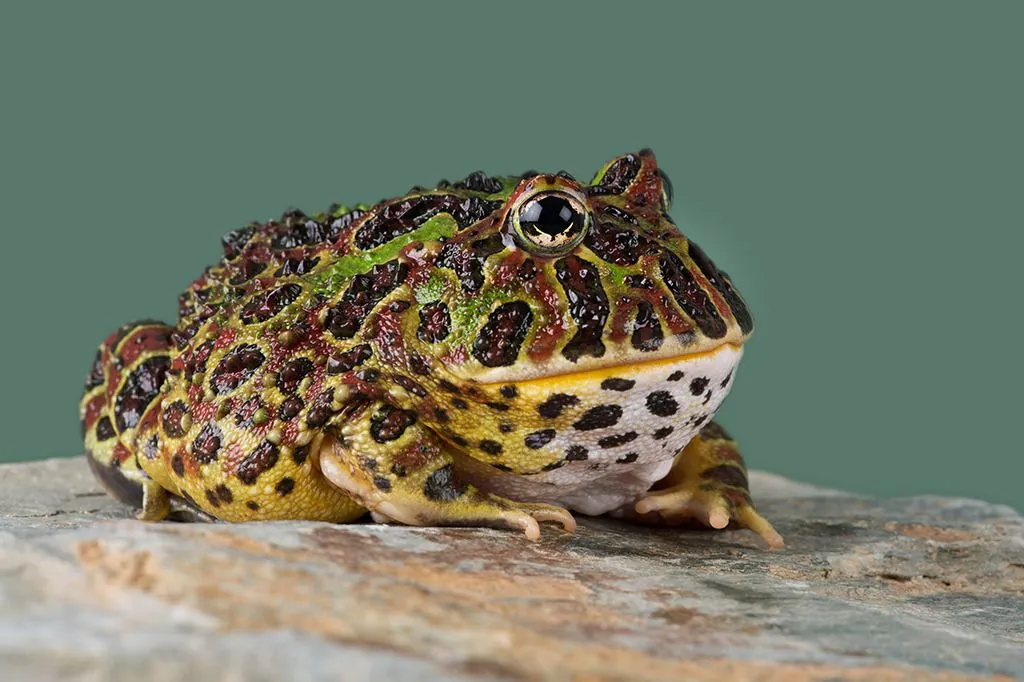
Ornate Horned Frog
Ceratophrys ornata
A stout, burrowing ambush frog from the South American Pampa, often sold as a Pac-Man frog. It is a hardy display amphibian that needs solitary housing, minimal handling, and disciplined feeding.
Overview
Ceratophrys ornata, the ornate or Argentine horned frog, is a terrestrial ambush predator from the Pampean grasslands of southern South America. In the pet trade it is one of several horned frogs nicknamed Pac-Man frogs. It spends long periods buried, feeds aggressively, and needs clean dechlorinated water, stable warmth, and minimal handling.
Native Regions
Argentina, Uruguay, Southern Brazil
Habitats
Pampean temperate grasslands (Pampa), Seasonal wetlands, ditches, and flooded grassland near temporary pools
Adult Length
Females about 5-6 inches (12-16 cm) snout-vent length; males about 3-4 inches (8-10 cm)
Adult Weight
Wild females reported up to about 500 g and males up to about 200 g; captive adults are often lighter depending on diet and sex
Lifespan
8–15 years
For Beginners
Basic setup and feeding are approachable for a prepared beginner, but absorbent skin, cannibalism risk, strong feeding response, and sensitivity to heat, saturation, and supplementation errors still require careful monitoring.
For Experienced Keepers
Experienced keepers can refine deep naturalistic substrate, low-level UVB, and feeder rotation while tracking body condition. Captive breeding is a specialist project involving aestivation, large aquatic spawning setups, and carnivorous tadpoles.
Key Points
- › Solitary, fossorial display frog rather than a handling pet
- › Native to temperate grassland and seasonal wetlands, not rainforest
- › Can live many years with careful feeding and water quality
Appearance & Behavior
A broad, round-bodied frog with a very large mouth, short limbs, and horn-like ridges above the eyes. Wild-type coloration is typically green to brown-green with darker blotches; captive morphs vary widely. Females grow substantially larger than males.
Normal Behavior
Mostly nocturnal and sedentary, remaining partly or fully buried and ambushing prey. Long inactive periods are normal when temperature, hydration, appetite, skin, and body condition remain healthy.
Social Behavior
House one frog per enclosure. Ornate horned frogs are territorial and cannibalistic; cohabitation risks stress, biting, injury, and predation.
Warning Signs
Persistent refusal to eat with weight loss, severe bloating, straining, prolapse, weakness, abnormal breathing, red or ulcerated skin, foul odor, discharge, swollen eyes, or limb and jaw deformity are not normal.
Key Points
- › Nocturnal ambush predator
- › Long buried inactive periods are normal
- › Strictly solitary in captivity
Enclosure & Environment
Enclosure Size
Use at least 24 x 18 x 18 inches for one adult. This exceeds older 10-gallon minimums and better accommodates a warm side, cool retreat, water dish, and burrowing.
Enclosure Type
A secure, well-ventilated horizontal glass or PVC terrarium with more floor area than height.
Substrate
Provide at least 3 inches of soft, moisture-retentive, diggable substrate such as coconut fiber or an appropriate organic soil mix with leaf litter. Avoid gravel, bark chunks, fertilizers, and moss on feeding surfaces where it may be swallowed.
Heating
Maintain 75-82°F ambient air with a thermostatically controlled warm area around 82-85°F and allow a nighttime drop to 70-75°F. Measure warm and cool zones digitally. Avoid heating deep substrate from below.
Humidity
Maintain roughly 60-80% relative humidity with damp lower substrate, slight surface drying, and enough ventilation to prevent stagnant, waterlogged conditions. Use dechlorinated water only.
Lighting
Provide a gentle 10-12 hour photoperiod with shaded retreats. Low-output UVB is recommended for overall health; offer complete shade and a low-exposure zone. Do not use colored night bulbs.
Décor & Enrichment
Provide at least one hide, leaf or plant cover, and a shallow dechlorinated-water dish large enough for soaking but easy to exit.
Cleaning & Maintenance
Remove waste and uneaten food promptly; clean and refill the water dish daily and whenever soiled. Replace or service substrate before it becomes foul, and quarantine new amphibians.
Key Points
- › Minimum adult footprint: 24 x 18 inches
- › Deep damp substrate must not become swampy
- › Low-level UVB with shade is recommended
- › All heat requires a thermostat
Diet & Nutrition
Feed a varied, gut-loaded invertebrate diet and regulate portions by age and body condition. Obesity is common when meals are too large or frequent.
Food Types
Use earthworms, roaches, crickets, and locusts where legal as rotating staples. Silkworms and hornworms add variety. Fatty worms and frozen-thawed rodents are treats; vertebrate prey should be rare, and live rodents must never be offered.
Feeding Schedule
Offer juveniles small meals daily or every 1-2 days. Offer adults one moderate meal about every 3-5 days, extending the interval after a large meal and adjusting for body condition.
Supplements
Dust most juvenile insect meals and 1-2 adult meals per week with calcium, plus a multivitamin about weekly for juveniles and every 2-4 weeks for adults. Coordinate vitamin D3 with UVB exposure and product labels.
Hydration
Keep a shallow dish of dechlorinated water available at all times. Replace it daily and after fouling. Maintain moist lower substrate without keeping the frog continuously soaked.
Preparation
Use captive-raised feeders no wider than the frog's head. Gut-load insects, dust immediately before feeding, and use tongs or a clean feeding surface to reduce substrate ingestion.
Common Mistakes
Overfeeding, frequent rodents, oversized prey, poor gut-loading, indiscriminate high-D3 supplementation, unsafe substrate ingestion, and untreated tap water.
Key Points
- › Rotate gut-loaded invertebrate staples
- › Adults generally eat every few days, not daily
- › Size prey no wider than the head
Handling
Ornate horned frogs are display animals. Routine handling risks skin contamination, stress, falls, and painful bites.
Techniques
When movement is necessary, guide the frog into a clean damp container or use clean, moistened, powder-free nitrile gloves. Support the whole body close to a surface and keep contact brief.
Do's & Don'ts
Wash hands before and after enclosure work. Do not handle with dry hands or skin carrying soap, lotion, or sanitizer. Do not feed with fingers.
Taming
This species does not need taming and should not be conditioned for recreational handling.
Stress Signals
Stop if the frog inflates defensively, struggles, opens its mouth, bites, vocalizes, or shows abnormal breathing.
Key Points
- › Avoid routine handling
- › Use tong feeding and damp containers when movement is necessary
Health & Wellness
Common Health Issues
Obesity
Description
Excess body fat from meals that are too large or frequent, especially repeated vertebrate prey.
Symptoms
Body wider than long, heavy skin folds, declining mobility, and persistently excessive body condition.
Prevention
Track body condition, use varied invertebrate staples, space adult meals, and keep rodents rare or omit them.
Treatment
Have an amphibian-experienced exotic veterinarian assess body condition and create a safe feeding plan.
Metabolic bone disease and nutritional imbalance
Description
Skeletal and neuromuscular disease associated with unsuitable calcium, vitamin D3, UVB, or feeder nutrition.
Symptoms
Soft or misshapen jaw, tremors, weakness, swollen or deformed limbs, and difficulty catching prey.
Prevention
Feed varied gut-loaded prey, use measured amphibian-safe supplements, and provide recommended low-level UVB with shade.
Treatment
Seek prompt care from a qualified exotic veterinarian; correction requires diagnosis and controlled dietary changes.
Gastrointestinal impaction
Description
Blockage associated with swallowed substrate, gravel, or oversized prey.
Symptoms
Bloating, straining, reduced stool, appetite loss, lethargy, and possible prolapse.
Prevention
Use safe fine substrate, keep gravel out, size prey correctly, and feed from tongs when ingestion risk is high.
Treatment
Contact a qualified exotic veterinarian promptly. Do not force-feed or give unprescribed treatments.
Skin infection, including red-leg presentations
Description
Potential bacterial, fungal, or environmental skin disease; visible redness is a sign, not a diagnosis.
Symptoms
Red legs or belly, ulcers, sores, abnormal shedding, foul odor, swelling, or appetite loss.
Prevention
Maintain clean dechlorinated water, correct temperature and moisture, ventilation, and quarantine.
Treatment
Treat redness, ulcers, or systemic illness as urgent and seek an amphibian-experienced veterinarian.
Preventative Care
Arrange an annual examination with an amphibian-experienced veterinarian. Record weight, appetite, temperatures, humidity, supplements, and feeder types; quarantine new amphibians.
Emergency Signs — seek vet care immediately
Seek prompt exotic-veterinary care for severe bloating, prolapse, wounds, persistent weakness, abnormal breathing, red or ulcerated skin, swollen eyes, limb or jaw deformity, marked weight loss, or continuing refusal to eat. This guidance is educational and is not a diagnosis.
Key Points
- › Most preventable problems involve feeding, water, temperature, or moisture errors
- › Red skin, weakness, and severe bloating need prompt veterinary attention
Breeding
Wild ornate horned frogs breed after rainy-season emergence from aestivation in temporary pools. Captive breeding requires simulated dry and wet seasons and substantial tadpole housing.
Preparation
Attempt only with healthy adults under specialist guidance after arranging aestivation capacity, spawning pools, filtration, live foods, and homes for large numbers of offspring.
Breeding Process
Specialist guidance describes cooling and drying for aestivation, then warming, heavy misting, and shallow aquatic spawning areas. Males call and amplex females; remove adults after egg deposition to prevent egg predation.
Egg Care
Eggs adhere to submerged objects and hatch in about 2-4 days depending on water temperature. Remove infertile eggs promptly and maintain clean, aerated water.
Hatchling Care
Tadpoles are carnivorous and cannibalistic without cover and adequate food. Metamorphosis commonly takes about 4-6 weeks; provide easy land access and appropriate small prey for froglets.
Key Points
- › Breeding is specialist-level and seasonal
- › Large clutches and carnivorous tadpoles demand extensive planning
- › Wait until about 18-24 months before breeding attempts when possible