
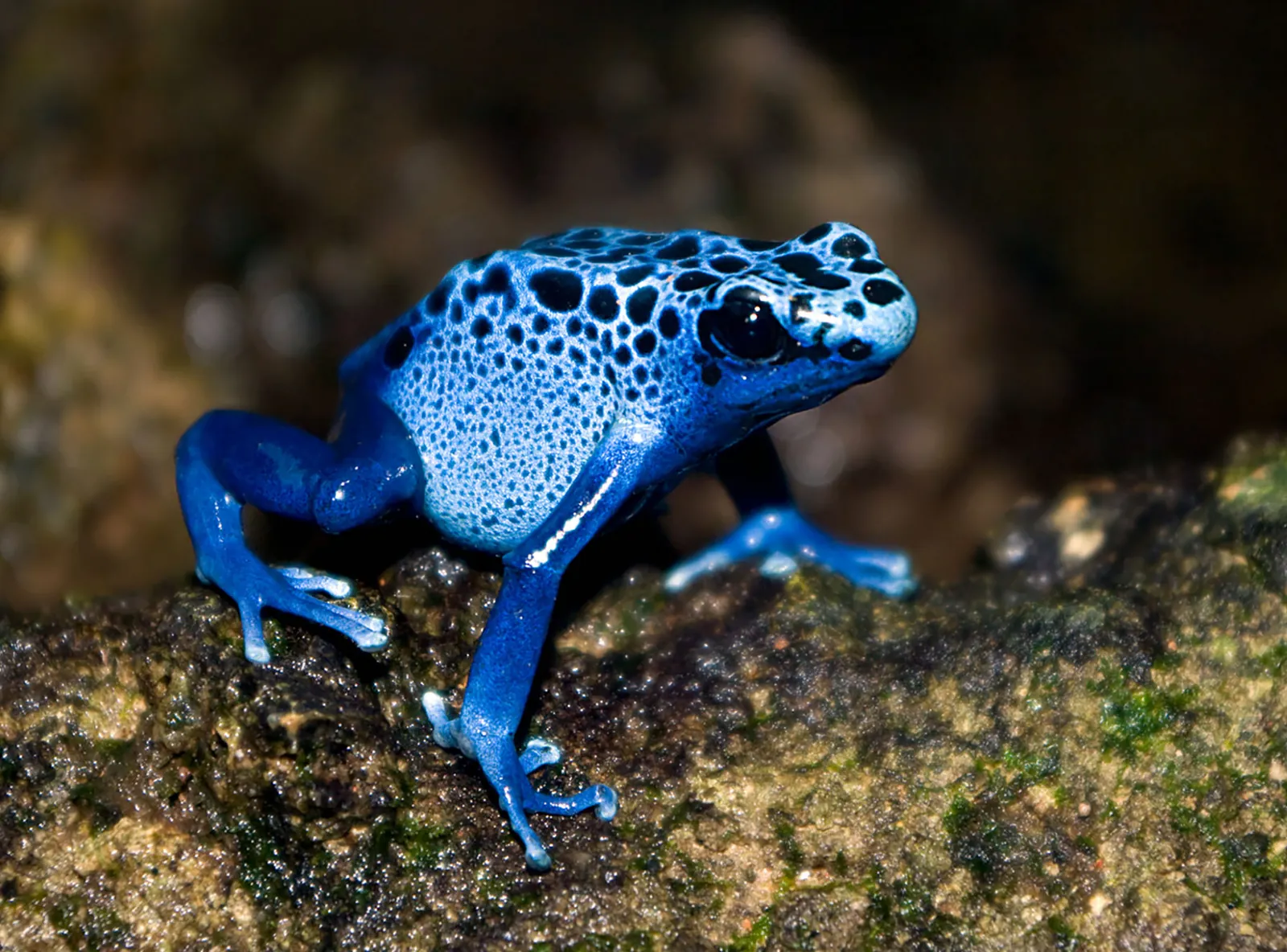
Poison Dart Frog
Dendrobates tinctorius
A diurnal, terrestrial poison frog from the Guiana Shield, represented here by the dyeing dart frog (D. tinctorius). Captive-bred animals need a humid planted vivarium, small live insects, and careful temperature control rather than routine handling.
Overview
This record describes Dendrobates tinctorius, the dyeing poison dart frog, a boldly patterned diurnal frog from the eastern Guiana Shield. Wild frogs can secrete potent skin alkaloids acquired from diet, but captive-bred animals on standard feeder insects do not retain meaningful toxicity to keepers. They are display amphibians that thrive in secure, planted, humid vivaria with reliable access to small live prey.
Native Regions
French Guiana, Suriname, Guyana, Northern Brazil (Pará and Amapá)
Habitats
Lowland tropical rainforest, Humid forest floor with deep leaf litter, Areas with canopy gaps and fallen wood, Small phytotelmata (water-holding sites) for tadpole deposition
Adult Length
About 1.8-2.5 inches (4.5-6 cm) snout-vent length; females usually larger and broader than males
Adult Weight
Roughly 5-15 grams in healthy captive adults depending on sex and morph; published weights vary by locality
Lifespan
10–20 years
For Beginners
Not a first reptile or amphibian for most people. A prepared keeper who already cultures fruit flies, understands bioactive vivarium basics, and can monitor temperature and humidity can succeed, but this is still an intermediate display species rather than a handling pet.
For Experienced Keepers
Experienced keepers can refine locality-appropriate group dynamics, UVI measurement, tadpole rearing, carotenoid and vitamin A schedules, quarantine, and chytrid-aware biosecurity while avoiding hybridization between morphs.
Key Points
- › Keep stable moderate temperatures; overheating above the low 80s°F is dangerous.
- › Maintain high humidity with drainage, airflow, and deep leaf litter—not a stagnant swamp.
- › Feed varied, gut-loaded fruit flies with consistent calcium and vitamin supplementation.
Appearance & Behavior
Medium-sized poison frogs with smooth skin and high-contrast patterning (black combined with yellow, white, blue, orange, or green depending on morph). Adults typically reach about 4.5-6 cm snout-vent length, with females broader and often slightly larger than males. Toe pad shape, back profile, and body width help sex mature animals after roughly 10-12 months.
Normal Behavior
Diurnal and alert, often foraging on the forest floor and exploring cover when the enclosure feels secure. Males may call softly near deposition sites. Normal frogs hunt actively, maintain body condition, and shed cleanly in a humid setup.
Social Behavior
Often kept as a sexed pair or carefully managed same-species group with ample floor space and visual barriers. Adult females can be territorial; observe for food monopolization or wrestling and separate if needed. Never mix species or morphs intended to remain pure locality lines.
Warning Signs
Persistent hiding, weight loss, weak feeding response, dull coloration, wrinkled skin, abnormal shedding, foot redness or sores, bloating, or sudden collapse especially during warm weather.
Key Points
- › Bold diurnal display frog when cover and humidity are correct.
- › Pairs or groups need space and monitoring for female aggression.
Enclosure & Environment
Enclosure Size
Minimum about 18 x 18 x 18 inches (45 x 45 x 45 cm) for one frog or a pair; larger footprints are strongly preferred for groups and aggression management. Plan roughly 10 gallons of space per adult as a conservative minimum.
Enclosure Type
Front-opening glass terrarium with limited top ventilation to retain humidity
Substrate
Well-drained tropical mix over a drainage layer; generous leaf litter on top. Avoid constantly waterlogged substrate that compacts and fouls feet and belly skin.
Heating
Prefer gentle room-level warmth; if supplemental heat is used, measure at substrate level and keep daytime ambient mostly in the low to mid 70s°F with nights down to about 65-72°F. Prolonged exposure above about 80-82°F causes rapid stress.
Humidity
Target about 80-100% relative humidity with daily misting (often once or twice daily depending on ventilation). Substrate and leaf litter should stay moist beneath the surface while upper surfaces and air exchange prevent sour, stagnant conditions.
Lighting
10-12 hour photoperiod with bright plant-suitable lighting. Low-level UVB (Ferguson zone 1; target roughly UVI 0.5-1.0 in exposed areas) is beneficial when measured and paired with full-shade retreats. Avoid harsh point basking for this species.
Décor & Enrichment
Multiple hides at ground level, cork flats, seed pods, film canisters or bromeliad axils for optional breeding deposition, and dense plants to break line of sight across open glass.
Cleaning & Maintenance
Remove uneaten prey, feces, and spoiled leaf litter promptly. Wipe glass as needed. In healthy bioactive systems, full substrate replacement may be years apart unless odor, compaction, or hydrology fails—then rebuild the drainage layer and substrate.
Key Points
- › Horizontal or cube footprint beats overly tall empty height.
- › Drainage plus leaf litter mimics the wild floor microclimate.
Diet & Nutrition
Strictly insectivorous; requires small, moving live prey. Captive nutrition depends on prey variety, gut-loading, and disciplined dusting because feeder insects alone do not replicate wild arthropod diversity.
Food Types
Staples are fruit flies (melanogaster for froglets, hydei for larger juveniles and adults). Springtails support small froglets. Bean beetles and small isopods add variety. Very small crickets or roach nymphs may suit large adults but are optional treats, not staples.
Feeding Schedule
Feed juveniles daily. Adults typically eat most days in modest portions—about five to six feedings weekly—or slightly less when prey items are larger. New arrivals may refuse food for a day or two while settling in.
Supplements
Calcium, vitamin D3, and broad multivitamins are essential in captivity. Many keepers use a complete dust at most feedings; others alternate calcium+D3 with multivitamins. Preformed vitamin A may be added occasionally for breeding animals following label limits to avoid hypervitaminosis A.
Hydration
Frogs absorb water through skin; mist with dechlorinated, RO, or spring water (avoid distilled or sodium-enhanced bottled water). Standing water bowls are optional and must stay clean if used; many keepers rely on misting and moist microhabitats instead of open pools.
Preparation
Gut-load flies before dusting. Coat feeders in a shallow cup with supplement powder, shake gently, and offer immediately. Alternate calcium-focused and multivitamin dustings per product instructions rather than random heavy dusting.
Common Mistakes
Overheating the room, leaving excess flies to harass frogs, skipping supplements, prey too large, stagnant wet substrate, and frequent handling or enclosure upheaval.
Key Points
- › Fruit flies plus consistent dusting are non-negotiable.
- › Portion control matters as much as prey type.
Handling
Display-only amphibian. Handling stresses animals and risks skin damage or transfer of soaps, oils, and pathogens through permeable skin.
Techniques
If relocation is unavoidable, coax the frog into a soft, damp container rather than pinching bare skin. Never use dry hands or gloves with residues.
Do's & Don'ts
Do observe and feed on a schedule; do quarantine new frogs. Do not handle for enjoyment, do not mix morphs or species, and do not assume wild-type toxicity applies to captive-bred stock.
Taming
Frogs may become bolder in a stable planted vivarium but should not be treated as tame pets. Confidence at the glass is not consent to handling.
Stress Signals
Jumping into tight hides for days, refusing food after disturbance, color dulling, or frantic escape attempts at glass.
Key Points
- › Observe; do not pet.
- › Use containers for moves and veterinary exams.
Health & Wellness
Common Health Issues
Heat stress and hyperthermia
Description
Poison frogs tolerate brief cool periods better than heat. Enclosures above about 80-82°F, especially without cooling, can rapidly cause decline.
Symptoms
Lethargy, splayed posture, sudden collapse, or death during heat waves or equipment failure.
Prevention
Monitor substrate-level temperature, use partial glass tops to balance humidity and heat, and have an emergency cooling plan in warm climates.
Treatment
Move to a cooler stable enclosure and contact a veterinarian experienced with amphibians immediately; this is an emergency.
Dehydration and poor hydrology
Description
Even humid enclosures can dehydrate frogs if ventilation, drainage, or misting fails.
Symptoms
Wrinkled skin, reduced activity, poor sheds, weight loss.
Prevention
Mist on schedule, maintain moist leaf litter, and prevent the enclosure from drying out completely between mistings.
Treatment
Correct humidity and hydrology; seek veterinary care if the frog does not rebound within a day.
Nutritional secondary hyperparathyroidism and vitamin imbalances
Description
Inadequate calcium, vitamin D3, vitamin A, or excessive supplementation can all harm amphibians.
Symptoms
Weakness, poor growth, limb deformities in growing animals, or reluctance to hunt.
Prevention
Follow a consistent dusting schedule, gut-load prey, and use low-level UVB with shade when recommended.
Treatment
Veterinary diagnosis and diet correction; do not guess supplement doses at home.
Chytridiomycosis (Bd) and other infectious disease
Description
Amphibian chytrid fungus occurs in wild and captive populations and requires professional management.
Symptoms
Nonspecific weight loss, skin shedding abnormalities, lethargy, or sudden deaths in collection outbreaks.
Prevention
Quarantine new frogs, source captive-bred stock, avoid cross-contamination of water and tools.
Treatment
Veterinary testing and prescribed antifungal protocols; never treat collections empirically without diagnosis.
Preventative Care
Weigh or photograph body condition monthly, test and log temperature and humidity, quarantine newcomers, and establish a relationship with an exotic veterinarian before emergencies.
Emergency Signs — seek vet care immediately
Collapse, inability to right itself, severe weight loss, open skin lesions, persistent anorexia beyond several days, or bloating with distress—seek exotic amphibian veterinary care promptly.
Key Points
- › Heat and dirty substrate cause more day-to-day losses than wild alkaloids in captivity.
- › Infectious disease needs veterinary testing, not home remedies.
Breeding
Captive breeding is common in dedicated hobbyist setups with deposition sites, tadpole rearing cups, and stable humidity cycling.
Preparation
House a proven male-female pair with film canisters, petri dishes in coconut huts, or bromeliad pools for egg deposition. Ensure excellent nutrition and vitamin A awareness before breeding season attempts.
Breeding Process
Females lay small clutches on moist surfaces or in canisters; males may transport tadpoles on their backs to water-filled deposition cups in the vivarium.
Egg Care
Keep eggs moist but not submerged; many keepers incubate pulled clutches near 75-77°F with dilute antifungal protocols used by experienced breeders. First clutches of a season may fail until conditions stabilize.
Hatchling Care
Rear tadpoles individually in clean tadpole tea with appropriate powdered foods; morph froglets at about 35-45 days under typical tinctorius schedules, then move to grow-out vivaria with daily supplemented melanogaster flies.
Key Points
- › Plan tadpole cups and strict morph purity.
- › Nutrition of parents affects froglet health.