
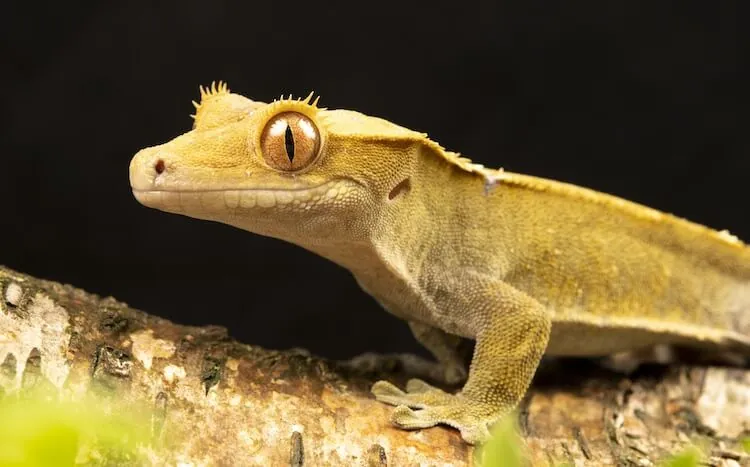
Crested Gecko
Correlophus ciliatus
A small, heat-sensitive, arboreal New Caledonian gecko with eyelash-like crests and adhesive toe pads. It thrives in a tall, planted enclosure with humidity cycles, low-level UVB, and a complete powdered gecko diet.
Overview
Correlophus ciliatus, the crested or eyelash gecko, is an arboreal diplodactylid from New Caledonia. Long thought extinct in the wild, it was rediscovered in the 1990s and is now widely captive-bred. Adults are modest in size, crepuscular to nocturnal, and adapted to relatively mild forest temperatures rather than hot basking deserts. They are popular beginner geckos because a complete powdered diet can replace live insects, but success still depends on vertical space, humidity cycling, ventilation, low-level UVB, and respecting their heat sensitivity.
Native Regions
New Caledonia (Grande Terre), Île des Pins (Isle of Pines) and nearby southern islands
Habitats
Tropical and subtropical rainforest canopy, Coastal forest and humid wooded lowlands, Secondary forest and vegetation near human settlement
Adult Length
About 7-9 inches (18-23 cm) total length with tail; snout-vent length often roughly 4-5 inches in adults
Adult Weight
Typically about 35-55 grams in healthy adults; juveniles start much smaller
Lifespan
10–20 years
For Beginners
A strong first gecko if you provide at least an 18 x 18 x 24 inch tall setup, digital thermometers and a hygrometer, evening misting with partial drying, low-level UVB with shade, and gentle handling. They are not a zero-maintenance pet: poor ventilation, constant saturation, or summer overheating are common failure points.
For Experienced Keepers
Experienced keepers can refine bioactive planting, Solarmeter-verified UV gradients near UVI 1-2, controlled breeding with calcium support for females, and carefully supervised female groups in oversized enclosures. Avoid casual cohabitation and never house males together.
Key Points
- › Arboreal and crepuscular, with excellent climbing and jumping ability
- › Can thrive on a complete powdered gecko diet with optional insects
- › Does not regenerate the tail after autotomy; heat stress above about 80°F is dangerous
Appearance & Behavior
Crested geckos have a slender body, large head, soft granular skin, and a fringed crest of enlarged scales above the eyes and along the dorsum. Sticky toe pads and a prehensile tail support climbing. Wild-type coloration ranges from olive, brown, and gray to orange or red with variable patterning; captive lines include many morphs. Adults are typically about 7-9 inches total length with tail and about 35-55 grams. Males have precloacal pores and a broader head; females are often slightly smaller.
Normal Behavior
Most activity occurs at dusk, dawn, and night: climbing, jumping, licking water droplets, and exploring foliage. By day they usually rest hidden in plants or cork. They may vocalize with soft chirps or barks. Jumping between hands or glass is normal when handled carefully.
Social Behavior
Solitary housing is the lower-risk default. Males must never be housed together. Some keepers maintain one male with multiple females or small female groups in very large, heavily furnished enclosures, but fighting, stress, and egg-laying strain still occur. Treat cohabitation as advanced management, not a beginner plan.
Warning Signs
Sunken eyes, weak grip, stuck shed especially on toes and tail tip, rapid weight loss, persistent lethargy, gaping, tail waving followed by drop, or hiding on the enclosure floor for days can signal dehydration, heat stress, parasites, or other illness.
Key Points
- › Eyelash crests, adhesive toes, and a prehensile tail suited to vertical life
- › Crepuscular and nocturnal rather than daytime-active
- › House one gecko per enclosure unless you have advanced space and experience
Enclosure & Environment
Enclosure Size
Minimum about 18 x 18 x 24 inches (45 x 45 x 60 cm) for one adult. Larger footprints and height (for example 18 x 18 x 36 inches) are better for long-term welfare and bioactive setups. Temporary smaller grow-out enclosures are fine for very small juveniles until they navigate a full adult cage safely.
Enclosure Type
Front-opening glass or PVC terrarium with a screened top for ventilation. Tall 'tall' style tanks are appropriate when escape-proof and easy to service.
Substrate
Coconut fiber, sphagnum-based mixes, or a well-drained bioactive soil layer work well. Avoid constantly wet bedding and fine particles that pack around the toes. Paper towel is acceptable for quarantine.
Heating
At typical room temperatures of about 70-78°F, supplemental heat is often unnecessary. Maintain a vertical gradient with the warmest perch around 75-79°F, cooler lower areas about 68-74°F, and nights in the upper 60s to low 70s °F. Avoid prolonged exposure above about 80°F, especially without a cooler retreat; sustained high temperatures can cause fatal heat stress. If the room runs cold, use a thermostat-controlled low-wattage ceramic heater or similar—not an unguarded hot rock.
Humidity
Aim for a daily cycle: mist in the evening to reach about 70-80% humidity, then allow the enclosure to dry toward about 50-60% before the next major misting. Constant saturation with poor airflow raises respiratory and skin-disease risk; chronically dry air causes stuck shed. Use dechlorinated or reverse-osmosis water for misting.
Lighting
Provide roughly 12 hours of light and 12 hours of darkness. Low-level UVB is recommended for long-term health even though animals can survive on fortified CGD alone. Target about UVI 1-2 at the gecko's upper resting areas using a shade-dwelling linear 5-6% UVB lamp positioned per manufacturer distance charts or a UV index meter, with dense shaded retreats below zero UVI. Replace UVB on schedule.
Décor & Enrichment
Provide horizontal and diagonal branches, cork flats, vines, and live or artificial plants for cover at several heights. Include a shallow CGD dish and ensure the gecko can drink from misted leaves or a clean water dish.
Cleaning & Maintenance
Remove uneaten CGD within 24 hours, spot-clean feces and shed, and wipe glass as needed. Deep-clean monthly with a reptile-safe disinfectant, rinsing and drying surfaces. Wash hands after contact because reptiles may carry Salmonella.
Key Points
- › Plan for at least 18 x 18 x 24 inches of usable vertical space
- › Pair evening misting with ventilation and a partial daytime dry-down
- › Use low-level UVB with shaded retreats and watch summer heat closely
Diet & Nutrition
Crested geckos are omnivorous frugivores. In captivity a complete powdered CGD is the practical staple because it balances protein, fruit, vitamins, and minerals. Feeder insects add enrichment and are optional for many adults when CGD is fed correctly.
Food Types
Use a reputable complete crested gecko diet as the main food. Offer gut-loaded crickets, roaches, or similar insects no wider than the space between the eyes if desired. Occasional soft fruit is optional variety only. Do not feed wild-caught insects, citrus-heavy fruit as a staple, or oversized prey.
Feeding Schedule
Most adults do well with fresh CGD about every other day; juveniles often need daily CGD while growing. If insects are used, offer them about 1-2 times weekly for adults and more often for growing juveniles, always removing uneaten live prey.
Supplements
Well-formulated CGD already includes calcium and vitamins; avoid stacking multiple D3 products without reason. Dust feeder insects with plain or low-D3 calcium when insects are part of the diet. Seek veterinary guidance before adding extra supplements to a CGD-only animal.
Hydration
Mist the enclosure in the evening so the gecko can drink droplets from leaves and glass. A shallow clean water dish is optional but helpful. Dehydration shows as sunken eyes and poor shed.
Preparation
Mix CGD powder with water to a ketchup-like consistency unless the manufacturer directs otherwise. Replace uneaten prepared diet within about 24 hours. Gut-load insects for 24-48 hours and dust lightly with calcium when insects are offered.
Common Mistakes
Relying on insects alone, leaving spoiled CGD in the dish, overfeeding insects, using fruit as the staple, ignoring summer overheating, and measuring humidity without allowing a dry-down period.
Key Points
- › Complete CGD is the captive staple
- › Insects are optional enrichment for many adults, not a requirement
- › Remove uneaten prepared diet promptly
Handling
Many crested geckos tolerate brief, gentle handling, but they are display geckos that do not need daily contact. Their skin is delicate and they jump readily.
Techniques
Scoop from below with a flat hand, support the body, and allow controlled jumps between hands kept low over a soft surface. Keep sessions short, especially with new animals or juveniles under about 15 grams snout-vent length.
Do's & Don'ts
Do not grab the tail, squeeze, or handle during the first week in a new home or when the gecko is shedding heavily. Supervise children. Avoid handling in bright midday heat or immediately after stressful enclosure work.
Taming
Predictable evening care and optional short handling build tolerance better than forced daily sessions. Many geckos remain jumpy for life and that is normal.
Stress Signals
Gaping, tail waving, loud barking, frantic jumping, or attempting to flee mean stop and return the gecko to cover.
Key Points
- › Support the body and expect jumping
- › Never pull or grab the tail
- › Keep sessions brief and skip handling during acclimation
Health & Wellness
Common Health Issues
Metabolic bone disease and calcium imbalance
Description
Insufficient calcium, vitamin D3, or UVB—or excessive supplementation—can weaken bones and jaws over time.
Symptoms
Soft jaw, limb tremors, weak grip, kinked tail, or difficulty climbing.
Prevention
Feed a complete CGD, provide low-level UVB with shade, dust insects appropriately, and avoid stacked D3 products without veterinary guidance.
Treatment
Requires diagnosis and treatment by a qualified reptile veterinarian; do not guess supplement doses at home.
Dehydration and stuck shed
Description
Low humidity, excessive heat, or inadequate drinking opportunities interfere with shedding, especially on toes and tail tips.
Symptoms
Sunken eyes, dull skin, retained shed bands on digits, or tail tip constriction.
Prevention
Evening misting with partial drying, clean water droplets, and temperatures below about 80°F.
Treatment
Correct husbandry first; retained toe shed or tail-tip injury needs veterinary help—do not cut skin at home.
Heat stress
Description
Crested geckos tolerate cool better than heat. Prolonged temperatures above about 80-82°F can be life-threatening.
Symptoms
Gaping, lethargy on the cage floor, rapid breathing, or collapse during heat waves.
Prevention
Monitor room and enclosure temperatures, provide shaded lower retreats, and relocate the enclosure or add cooling during heat spikes.
Treatment
Move to a cooler area immediately and contact a reptile veterinarian if signs persist.
Respiratory and skin infections
Description
Constantly wet, poorly ventilated enclosures can promote bacterial or fungal issues of the skin and respiratory tract.
Symptoms
Wheezing, open-mouth breathing, swelling, discolored skin patches, or foul odor.
Prevention
Humidity cycles with airflow, remove spoiled food, and avoid foggers that saturate the enclosure continuously.
Treatment
Needs veterinary diagnosis; antibiotics or antifungals require prescription guidance.
Preventative Care
Schedule an initial exam and periodic fecal checks with a reptile-experienced veterinarian, quarantine new animals, weigh monthly, test UVB and temperatures seasonally, and wash hands after handling.
Emergency Signs — seek vet care immediately
Seek prompt reptile-veterinary care for open-mouth breathing, collapse, severe lethargy, prolapse, major trauma, repeated refusal to eat with weight loss, or signs of heat stroke. This content is educational husbandry guidance, not a diagnosis.
Key Points
- › Heat, hydration, and UVB balance drive most preventable problems
- › Tail loss is permanent but compatible with a normal life when husbandry is sound
- › Use a qualified exotic veterinarian for diagnosis and treatment
Breeding
Crested geckos are oviparous and can be prolific in captivity. Breeding should be intentional because females need calcium support, lay repeated clutches, and cohabitation carries injury risk.
Preparation
House only compatible adults with clear identification, oversized space, multiple feeding stations, and a lay box with moist sphagnum or similar substrate. Have homes planned for offspring and veterinary support for egg binding.
Breeding Process
After successful pairing, females typically lay two glued eggs about every 30-45 days during the breeding season. Males can be separated after breeding if aggression appears.
Egg Care
Incubate at roughly 70-78°F with stable moisture; higher temperatures shorten incubation but can affect development. Many clutches hatch in about 60-90 days.
Hatchling Care
House hatchlings individually or in small groups only with ample space, daily CGD, gentle humidity, and minimal handling until they gain weight steadily.
Key Points
- › Pairs produce repeated two-egg clutches
- › Females need excellent nutrition and calcium support
- › Treat breeding as a specialist project, not a beginner side effect