
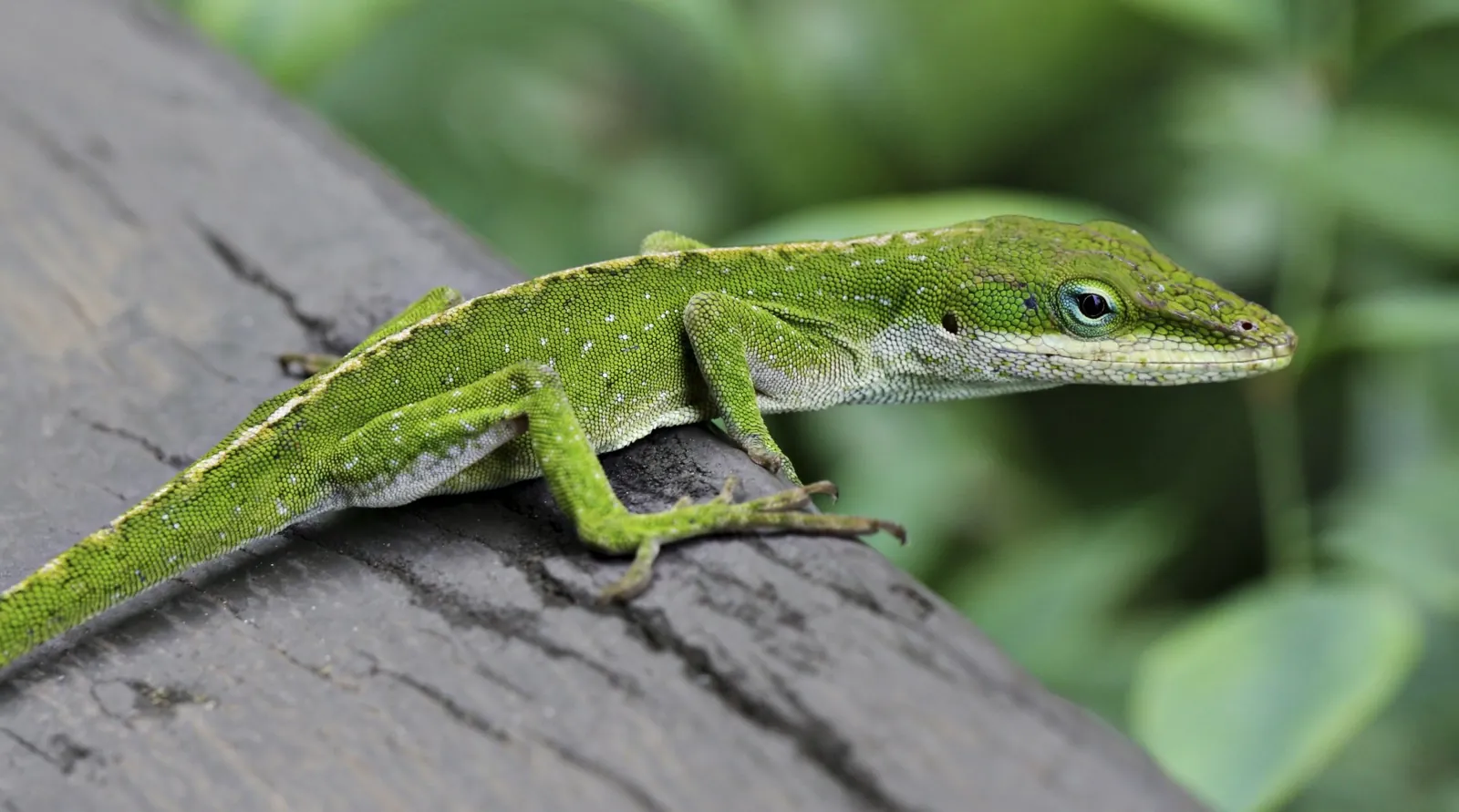
Green Anole
Anolis carolinensis
A small, diurnal, arboreal lizard native to the southeastern United States, known for color change between green and brown, sticky toe pads, and an active hunting style. Better as a display animal than a handling pet; needs vertical space, UVB, humidity, and live insects.
Overview
The green anole (Anolis carolinensis), also called the Carolina anole, is a small diurnal lizard native to the southeastern United States and widely kept in the pet trade. Adults are typically about 5-8 inches long with adhesive toe pads, a slender body, and—especially in males—a pink to orange throat dewlap used in display. They can shift between bright green and brown based on temperature, stress, and social context, which led to the misleading nickname “American chameleon.” They are active visual hunters that do best in tall, planted enclosures with UVB, a heat gradient, and regular misting.
Native Regions
Southeastern United States (coastal plain from North Carolina through Florida west to Texas)
Habitats
Open pine and hardwood forest edges with shrubs and vines, Tall grasses and sunlit vegetation with nearby cover, Gardens, fences, and suburban plantings
Adult Length
About 5-8 inches total length (males usually larger; roughly half is tail)
Adult Weight
About 3-7 grams (roughly 0.1-0.25 ounces)
Lifespan
4–8 years
For Beginners
Often marketed as a beginner lizard because animals are inexpensive, but thriving captive care is not low-effort. Success requires live insects, a tall planted setup, linear UVB, measured temperatures, and daily misting. Skittishness and escape risk make them a weak choice if the main goal is handling.
For Experienced Keepers
Experienced keepers can refine bioactive planted vivaria, measured UVB (about Ferguson Zone 2 / moderate UVI at the basking perch), seasonal photoperiods, and carefully managed breeding with laying sites and female condition monitoring.
Key Points
- › Diurnal, arboreal insectivore from the southeastern United States.
- › Needs vertical space, UVB, basking heat, and moderate humidity with drinking droplets.
- › Usually a display lizard; frequent handling and male-male housing are poor fits.
Appearance & Behavior
Slender lizards with a pointed snout, long thin tail (often roughly half the total length), small granular scales, and expanded toe pads for climbing. Adults are usually about 5-8 inches and only a few grams. Typical color ranges from bright green to brown or gray; females and juveniles often show a pale dorsal stripe. Males are usually larger and have a larger, pink to orange dewlap used in territorial and courtship displays.
Normal Behavior
Active by day. They climb, hunt insects by sight, bask in warm lit perches, and use head-bobs and dewlap displays. Males defend territories. Color may darken when cool or stressed and brighten when warm and settled.
Social Behavior
Adult males are strongly territorial and should not share an enclosure. Females may sometimes be housed together or with a single male only in large, heavily planted setups with multiple basking and feeding sites, but breeding pressure and competition are common. Single housing is the safest default for welfare and observation.
Warning Signs
Persistent lethargy, weight loss, weak grip or climbing difficulty, swollen jaws or limbs, tremors, sunken eyes, open-mouth breathing, wheezing, retained shed on toes or tail tip, chronic dark coloration with poor appetite, or trauma wounds warrant husbandry review and exotic veterinary care.
Key Points
- › Small climbing lizard with color change and a male dewlap display.
- › Diurnal hunter that needs dense cover and elevated perches.
- › Do not house adult males together.
Enclosure & Environment
Enclosure Size
Minimum about 24 x 24 x 24 inches for one adult. Some veterinary guides cite about 18 x 18 x 24 inches as a smaller absolute floor; larger and taller is strongly preferred, especially for pairs or groups.
Enclosure Type
Front-opening glass or PVC terrarium with a secure screen top or tight doors. Tall footprints are preferred over short “10-gallon” starter tanks.
Substrate
Moisture-holding options such as coconut fiber, organic topsoil mixes, cypress mulch, or bioactive tropical mixes work well. Avoid calcium sand, walnut shell, cedar, pine shavings, and other irritating or impaction-prone products.
Heating
Create an overhead basking surface about 88-92°F with daytime ambient temperatures roughly 75-85°F from cool shaded areas to the warm upper zone. Nights may fall to about 65-72°F. Measure the basking perch and a shaded retreat; never use hot rocks.
Humidity
Aim for about 60-70% average relative humidity with good ventilation so the enclosure partly dries between mistings. Mist morning and evening to create drinking droplets. Avoid chronically stagnant, soaked air.
Lighting
Provide bright visible light plus linear UVB for about 10-12 hours daily (some keepers seasonally adjust day length). Target a moderate UVB gradient at the upper basking perch with shaded cover nearby. Replace UVB lamps on the manufacturer’s schedule; compact coil bulbs are a poor primary UVB source for this species.
Décor & Enrichment
Offer thin branches and vines at multiple heights and angles, cork, live or artificial leafy plants, visual barriers, and at least one humid or densely planted retreat. Keep a shallow water dish available even though most drinking is from droplets. Females need a moist laying area.
Cleaning & Maintenance
Spot-clean feces and soiled substrate daily, refresh water, and deep-clean or replace substrate on a regular schedule (often monthly to every few months depending on setup). Wash hands before and after contact because reptiles can carry Salmonella.
Key Points
- › Use a tall, escape-proof enclosure—about 24 x 24 x 24 inches minimum for one adult.
- › Combine overhead basking heat, linear UVB, and dense climbing cover.
- › Mist for humidity and drinking droplets while keeping ventilation adequate.
Diet & Nutrition
Green anoles are primarily insectivorous. Captive diets should be varied live invertebrates of appropriate size, not fruit or plant matter as staples.
Food Types
Staples include gut-loaded crickets and small feeder roaches; hatchlings often need fruit flies or pinhead crickets. Soft-bodied feeders and black soldier fly larvae add variety. Mealworms and waxworms are occasional treats only because of fat content. Wild ADW notes occasional plant matter in nature, but husbandry sources treat captive animals as strict insectivores.
Feeding Schedule
Feed juveniles daily. Feed healthy adults every other day or about three to five times weekly, adjusting to keep a healthy body condition without obesity.
Supplements
Dust most feeds with phosphorus-free calcium. Use a reptile multivitamin about weekly. With reliable UVB, avoid overusing high-D3 powders without veterinary guidance.
Hydration
Mist so droplets form on leaves and décor; many anoles drink from droplets more readily than from bowls. Still provide a shallow clean water dish and refresh it daily.
Preparation
Gut-load insects for at least 24 hours and hydrate them well. Offer prey no larger than the width between the eyes. Use a feeding ledge or tongs when helpful, and remove uneaten insects so they do not harass the lizard.
Common Mistakes
Relying on a single feeder species, skipping gut-loading or calcium, offering oversized prey, using fruit as a regular food, leaving crickets overnight, and underproviding UVB or calcium leading to metabolic bone disease.
Key Points
- › Varied, gut-loaded insects are the captive staple.
- › Size prey to the head and supplement calcium regularly.
- › Hydration depends heavily on misting droplets.
Handling
Green anoles are generally display animals. They are fast, easily stressed, and can drop the tail (autotomy) if grabbed. Routine handling is not recommended.
Techniques
When a move is necessary, coax into a clear cup or container rather than chasing by hand. If brief hand contact is unavoidable, support the body gently and keep the session over a soft surface near the enclosure.
Do's & Don'ts
Never grab or restrain the tail. Do not handle new arrivals for at least one to two weeks while they settle and eat. Avoid frequent handling, children chasing the lizard, and mixing species in one habitat.
Taming
Build trust mainly through calm presence and tong-feeding rather than forced handling. Many individuals never become calm handleable pets.
Stress Signals
Rapid fleeing, frantic jumping, dark stress coloration, open-mouth threats, biting, or refusal to eat after disturbance mean stop interaction and review husbandry.
Key Points
- › Prefer observation and tong-feeding over handling.
- › Never restrain the tail.
- › Allow settling time before any necessary contact.
Health & Wellness
Common Health Issues
Metabolic bone disease
Description
Bone and muscle problems from inadequate calcium, vitamin D pathways, and/or UVB exposure—common when “cheap” anole setups omit proper lighting and supplements.
Symptoms
Weakness, tremors, soft or swollen jaws or limbs, deformities, reduced climbing ability, fractures.
Prevention
Provide linear UVB, a correct heat gradient, gut-loaded insects, and regular calcium supplementation.
Treatment
Contact a qualified exotic veterinarian promptly; supportive husbandry corrections alone are not a substitute for veterinary assessment of advanced cases.
Dehydration and dysecdysis (retained shed)
Description
Low humidity, poor misting, or chronic stress can cause incomplete sheds, especially around toes and the tail tip, and contribute to dehydration.
Symptoms
Constricted bands of old skin on digits or tail, dull patches of stuck shed, sunken eyes, lethargy.
Prevention
Maintain about 60-70% humidity with daily misting peaks, good ventilation, and a humid retreat; never peel stuck shed forcefully.
Treatment
Improve humidity and hydration; seek veterinary care if constriction persists or circulation looks impaired.
Respiratory infection
Description
Often associated with incorrect temperatures, chronically wet stagnant air, or other husbandry stress.
Symptoms
Open-mouth breathing, wheezing, mucus at the nostrils, lethargy, reduced appetite.
Prevention
Keep a proper thermal gradient, avoid cold damp conditions, and balance humidity with ventilation.
Treatment
Seek exotic veterinary care; antibiotics or other therapies must be prescribed by a veterinarian.
Parasites and trauma
Description
Wild-caught animals frequently carry internal parasites; captive injuries include burns from unguarded heat, cohabitation wounds, and escape trauma.
Symptoms
Weight loss despite feeding, abnormal feces, wounds, missing or regenerating tails, burn lesions.
Prevention
Quarantine new animals, request fecal testing, use guarded overhead heat, house males separately, and secure the enclosure.
Treatment
Veterinary fecal testing and treatment for parasites; wounds and burns need professional care.
Preventative Care
Schedule wellness exams every 6-12 months with annual fecal testing when possible. Monitor appetite, body condition, shedding, and climbing daily through observation rather than frequent handling.
Emergency Signs — seek vet care immediately
Open-mouth breathing, severe lethargy, refusal to eat for more than about a week, rapid weight loss, inability to climb, limb or jaw swelling, egg-binding signs in females, constricting retained shed, or traumatic injury—seek a qualified exotic veterinarian promptly. This content is educational husbandry guidance, not a diagnosis.
Key Points
- › Most illness traces to humidity, UVB/calcium, temperature, or social stress errors.
- › Watch climbing ability, shed quality, and weight closely.
- › Use exotic veterinary care early rather than waiting.
Breeding
Oviparous. In the native range, breeding is concentrated in warmer months. Captive breeding is possible but continuous reproduction can exhaust females without excellent nutrition, UVB, and recovery time.
Preparation
Confirm both animals are healthy and mature. Provide calcium, UVB, multiple retreats, and a moist laying site (damp soil or similar) for the female. Do not keep adult males together.
Breeding Process
Males display with dewlap extension and head-bobs. Females typically produce single eggs (sometimes two) at roughly two-week intervals through the season, totaling several eggs per year.
Egg Care
Collect eggs carefully if incubating artificially. Incubate around 80-85°F with moderate humidity for about 30-45 days (about 5-7 weeks).
Hatchling Care
House hatchlings separately or in carefully managed groups with ample cover. Offer pinhead crickets, fruit flies, and other tiny feeders with calcium support and UVB.
Key Points
- › Seasonal egg-layers that usually deposit one egg at a time.
- › Incubation is commonly about 5-7 weeks near 80-85°F.
- › Protect female condition; separate males.