
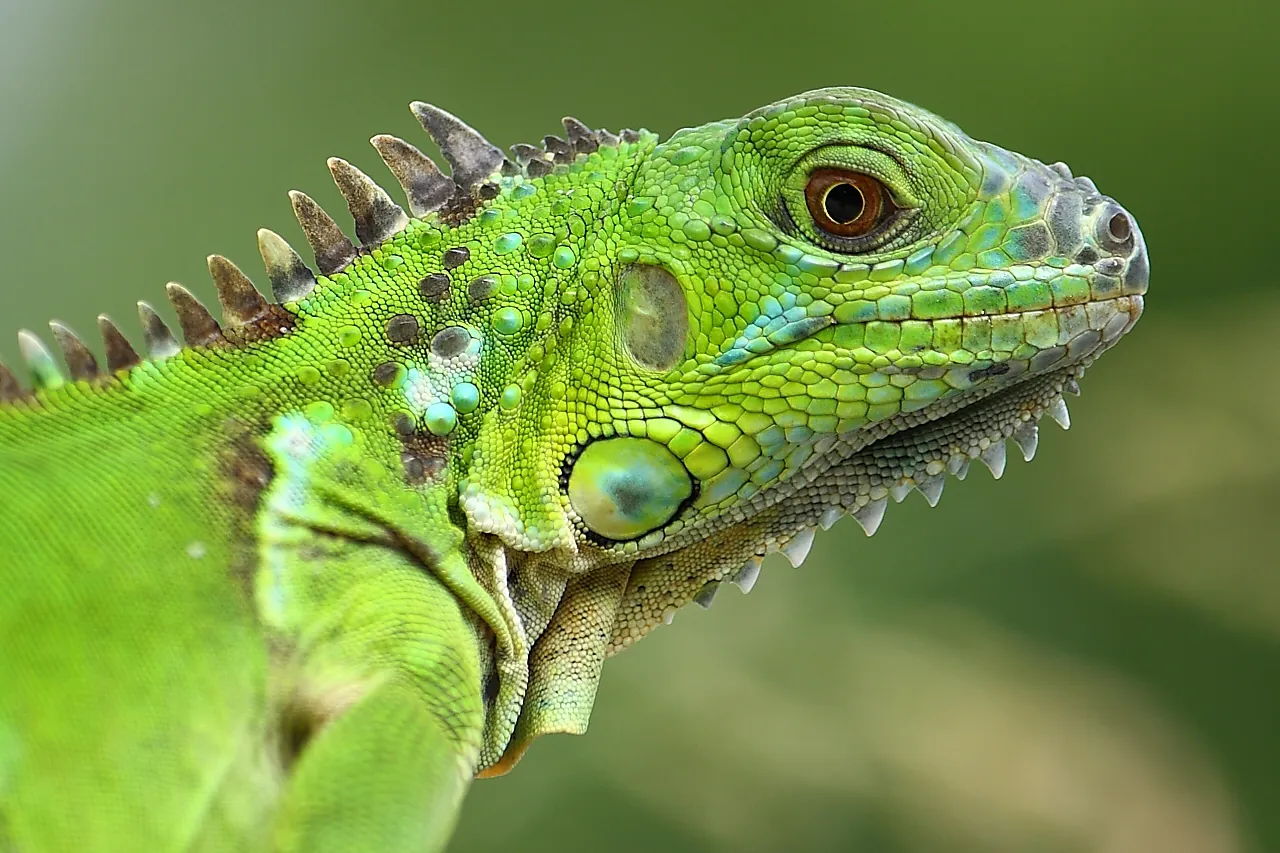
Green Iguana
Iguana iguana
A large, diurnal, arboreal herbivorous lizard native to tropical forests from Mexico through Central and South America, known for its dewlap, dorsal spines, long whip-like tail, and demanding space, humidity, and UVB needs in captivity.
Overview
The green iguana (Iguana iguana), also called the common green iguana, is a large arboreal herbivore native to tropical forests from southern Mexico through Central America and much of northern and eastern South America, with natural island populations and many introduced localities. Juveniles are often bright green; adults may become gray-green, brown-green, orange-tinged, or other regional color morphs while retaining a dewlap, dorsal spines, and a long muscular tail used for balance and defense.
Native Regions
Southern Mexico through Central America, Northern and eastern South America to Paraguay and southeastern Brazil, Natural Caribbean and offshore island populations; introduced in Florida, Hawaii, and elsewhere
Habitats
Humid tropical rainforest edges near rivers, lakes, and clearings, Dry and gallery forest, Savannah with trees and shrub vegetation on some islands
Adult Length
Typically about 4-6 feet total length including the long tail; large males may reach about 6-7 feet
Adult Weight
Typically about 5-15 pounds; large adult males may reach about 15-20 pounds
Lifespan
10–20 years
For Beginners
Not recommended. Adults commonly need custom or room-scale enclosures, high humidity with strong ventilation, measured UVB, and daily greens preparation. Mature animals can scratch, bite, or whip with the tail, and they are a poor fit for young children.
For Experienced Keepers
Suitable for experienced keepers who can build and maintain a large humid, brightly lit arboreal habitat, measure heat and UV gradients, commit to daily diet and cleaning, and manage seasonal aggression, especially in intact adult males.
Key Points
- › Large diurnal arboreal herbivore requiring walk-in scale housing
- › Strict plant-based diet with UVB and calcium management critical
- › Expert-level pet: space, humidity, and temperament demands are high
Appearance & Behavior
A heavy-bodied lizard with a prominent dewlap, a crest of vertebral spines, long toes and claws, and a long banded tail that often makes up much of total length. Total length is commonly about 4-6 feet; large males may approach or exceed about 6-7 feet and can weigh roughly 15-20 pounds. Males typically have larger heads, dewlaps, dorsal spines, and femoral pores than females.
Normal Behavior
Diurnal and largely arboreal: they bask, climb, and forage in vegetation, descending mainly to move between patches or to nest. Tongue-flicking explores scent. Territorial displays, head-bobbing, and dewlap extension are normal social signals, especially in breeding season.
Social Behavior
Adults are territorial; males should not be housed together. Routine cohabitation is not recommended for companion animals because of injury risk. Hatchlings may form temporary social groups in the wild, but captive pets are best kept singly unless a very large, carefully managed breeding program justifies otherwise.
Warning Signs
Persistent lethargy, refusal to eat, soft or swollen jaw or limbs, tremors, open-mouth breathing, nasal discharge, dull or unusually dark coloration with poor body condition, inability to climb or support the body, or sudden aggression beyond seasonal patterns.
Key Points
- › Arboreal climber that needs sturdy elevated basking and resting sites
- › Best housed alone; adult males are especially territorial
Enclosure & Environment
Enclosure Size
Modern husbandry guidance for one adult commonly starts around 10 feet long by 5 feet wide by 6 feet high (120 x 60 x 72 inches), with larger preferred. Some veterinary sheets still cite about 6 x 3 x 6 feet as a minimum; treat that as a historical floor and aim for the larger walk-in footprint whenever possible.
Enclosure Type
Custom-built walk-in or room-scale arboreal habitat; commercial aquariums are unsuitable for adults.
Substrate
Large-particle moisture-retaining options such as cypress mulch or coconut products sized to reduce accidental ingestion, or a well-drained soil-based mix if bioactive. Spot-clean feces promptly; deep-clean or refresh substrate on a regular schedule.
Heating
Use broad overhead radiant heat so the iguana can warm most of its body. Measure basking surface temperature with an infrared thermometer and ambient air with digital probes. Aim for a hot basking surface near 100-115°F, daytime ambient air about 78-88°F, and nighttime air about 70-78°F with a normal drop. Never use heat rocks.
Humidity
Maintain daytime average relative humidity about 60-80% with good ventilation; night humidity may spike higher after misting. Mist daily (automated systems help in large habitats), offer a large water tub, and avoid stagnant wet conditions that promote respiratory and skin problems.
Lighting
Provide bright daytime visible light plus linear T5-HO UVB for about 12-13 hours daily. Target roughly UVI 3-4 at the main basking perch with true shade available. Ordinary window glass blocks useful UVB. Overlap heat and UVB at the bask and leave cooler, darker retreats.
Décor & Enrichment
Heavy-duty branches, shelves, and platforms at multiple heights; live non-toxic tropical plants for cover and humidity; visual barriers; and a diggable nesting volume for gravid females. Artificial plants are often chewed and can cause foreign-body problems.
Cleaning & Maintenance
Change fouled water daily. Spot-clean waste daily. Disinfect bowls and heavily soiled areas regularly with a reptile-safe disinfectant. Deep-clean substrate and hardscape on a schedule matched to enclosure size and soiling.
Key Points
- › Adult minimum on the order of 10 x 5 x 6 feet, not a glass aquarium
- › Measured heat, bright light, UVB, and humid but ventilated air are essential
Diet & Nutrition
Strictly herbivorous at all ages. Build the diet around dark leafy greens with a favorable calcium-to-phosphorus balance; add other vegetables for variety; keep fruit a small fraction. Animal protein as a staple (dog/cat food, rodents, insects as the main meal) is inappropriate and linked to kidney and metabolic disease.
Food Types
Staple leafy greens include collard, mustard, dandelion, turnip greens, escarole, and similar dark greens. Mix in chopped or grated squash, zucchini, bell pepper, green beans, sweet potato, and other vegetables. Limit fruit (papaya, melon, mango, berries) and offer edible flowers such as hibiscus occasionally. Avoid iceberg lettuce as a staple and never rely on animal protein.
Feeding Schedule
Feed a fresh mixed salad daily. Growing juveniles and gravid females have higher calcium needs and should not go without appropriate greens.
Supplements
Use a phosphorus-free calcium supplement more frequently for juveniles and less often for non-breeding adults that receive measured UVB (often about weekly for adults per veterinary sheets). A multivitamin or complete herbivore powder about weekly is commonly recommended. Follow exotic-veterinarian advice for breeding animals and for products containing vitamin D3.
Hydration
Provide a large, clean water vessel deep enough for soaking; many iguanas defecate in water, so clean daily. Mist the enclosure and food to support hydration in addition to drinking.
Preparation
Chop or grate produce into bite-sized pieces. Offer variety across the week rather than a single green. Remove uneaten food before it spoils. Supervise free-roam areas so the iguana cannot eat toxic houseplants or foreign objects.
Common Mistakes
Feeding animal protein or commercial omnivore mixes as staples; relying on fruit or pale lettuce; skipping UVB so dietary calcium cannot be used; housing in dry, cool cages that worsen metabolic disease; and underestimating adult food volume and waste.
Key Points
- › Greens-heavy herbivore diet every day
- › Calcium balance plus UVB prevents the most common captive disease
Handling
Many green iguanas can learn to tolerate and even seek calm interaction, but they are not automatically gentle pets. Sharp claws, a strong bite, and a whip-like tail can injure people. They are best suited to skilled keepers, not young children.
Techniques
Allow settling time before forced handling. Approach slowly from the side or below, scoop and fully support the body and hindquarters, and avoid dangling the lizard. Never grab the tail. Wear protective clothing if seasonal aggression or unpredictable biting is a concern.
Do's & Don'ts
Do build trust with short, positive sessions and hand-feeding. Do not restrain by the tail, approach from above like a predator, punish defensive behavior, or force prolonged handling of a stressed animal. Do not assume a friendly juvenile will remain easy to handle as a territorial adult male.
Taming
Consistency over weeks to months matters more than long sessions. Let the iguana watch daily care, then progress to touch and voluntary climbing onto the keeper. Supervised free-roam outside the enclosure can enrich adults but is not a substitute for correct heat, humidity, and UVB indoors.
Stress Signals
Tail whipping, hissing, open-mouth threats, dark stress coloration, frantic fleeing, or repeated biting attempts. Stop and give space when these appear.
Key Points
- › Handleable with patience and full body support
- › Expect claws, bites, and seasonal male aggression
Health & Wellness
Common Health Issues
Metabolic bone disease (nutritional secondary hyperparathyroidism)
Description
The most common serious disease of captive green iguanas, driven by diets low in calcium or with poor calcium-to-phosphorus balance, inadequate UVB for vitamin D3 synthesis, and suboptimal temperatures that impair digestion and calcium use.
Symptoms
Lethargy, soft or swollen jaw ("rubbery jaw"), swollen or deformed limbs, tremors or tetany, fractures, spinal deformity, weakness, and reduced appetite.
Prevention
Herbivorous diet rich in calcium-positive greens, phosphorus-free calcium supplementation appropriate to life stage, measured UVB with shade, and correct thermal gradients.
Treatment
Contact a qualified exotic veterinarian promptly. Supportive care may include calcium and vitamin D therapy, fluids, diet and husbandry correction, and management of fractures; do not attempt to diagnose or treat at home as a substitute for veterinary care.
Renal disease
Description
Kidney disease is frequently linked to chronic dehydration, improper diet (including excess animal protein), and advanced metabolic imbalance.
Symptoms
Lethargy, reduced appetite, weight loss, weakness, and abnormal bloodwork on veterinary testing.
Prevention
Strict herbivorous diet, reliable humidity and water access, correct temperatures, and routine veterinary monitoring.
Treatment
Seek exotic veterinary evaluation; supportive care and husbandry correction only under veterinary direction.
Respiratory infection
Description
Often associated with cool temperatures, chronically poor humidity control, poor ventilation, or overall husbandry stress.
Symptoms
Open-mouth breathing, nasal or ocular discharge, lethargy, and reduced appetite.
Prevention
Stable warm gradients, humid but well-ventilated air, and prompt correction of cold or stagnant conditions.
Treatment
Prompt exotic veterinary care; antibiotics or other therapy only as prescribed.
Abscesses, stomatitis, and traumatic injury
Description
Abscesses and mouth infections can follow bites, scratches, or poor hygiene. Tail autotomy and claw injuries occur with rough handling or unsafe furniture.
Symptoms
Localized swellings, oral plaques or redness, reluctance to eat, missing or regenerating tail segments, and bleeding wounds.
Prevention
Safe enclosure design, solitary housing defaults, gentle handling, and good sanitation.
Treatment
Veterinary assessment for drainage, culture, wound care, or pain management as indicated.
Egg binding (dystocia) and reproductive disease
Description
Gravid females without adequate nesting sites, calcium status, or body condition may be unable to pass eggs.
Symptoms
Straining, lethargy, anorexia, coelomic swelling, and weakness.
Prevention
Appropriate nesting substrate, excellent calcium and UVB husbandry, and avoiding breeding of unfit animals.
Treatment
Emergency exotic veterinary care; this is not a wait-and-see home condition.
Preventative Care
Annual (or more frequent) exams with a reptile-experienced veterinarian, fecal parasite checks for new or outdoor-exposed animals, Salmonella hygiene practices for all household members, and continuous attention to diet, UVB lamp age/distance, temperature, and humidity. Educational husbandry guidance is not a substitute for diagnosis or treatment.
Emergency Signs — seek vet care immediately
Open-mouth breathing, severe lethargy, collapse, tremors or seizures, inability to move limbs, complete anorexia lasting more than a couple of days in a previously healthy animal, prolapses, unresolved egg-laying straining, or traumatic bleeding. Contact an exotic veterinarian or emergency clinic immediately.
Key Points
- › MBD from diet and UVB failure is the signature captive disease
- › Warmth, humidity, hydration, and veterinary exams prevent most crises
Breeding
Oviparous. Wild reproduction is tightly tied to tropical wet and dry seasons, so calendar timing varies with hemisphere and latitude. Captive breeding requires substantial space, nesting substrate, and veterinary readiness for dystocia.
Preparation
Breed only healthy adults of adequate size. Provide deep, diggable, moist nesting substrate for gravid females. Separate or carefully manage males during the breeding season because territorial aggression increases. Unmated females can still produce eggs.
Breeding Process
Males establish breeding territories with displays and combat. Females typically produce one clutch per annual nesting season in documented populations, with mean clutch size often near 35 eggs (range about 9-71).
Egg Care
Incubate in a controlled humid incubator for roughly 2-3 months (often about 90 days; published artificial incubation means near 92 days). Stable temperature and moisture matter for hatching success and neonate quality; seek species-specific protocols before attempting incubation.
Hatchling Care
Hatchlings need appropriately scaled humid arboreal housing, daily greens, UVB, and heat. They grow quickly and outgrow temporary cages, so plan adult housing early.
Key Points
- › Large clutches timed to tropical dry/wet seasons
- › Nesting space and dystocia risk make breeding an advanced undertaking