
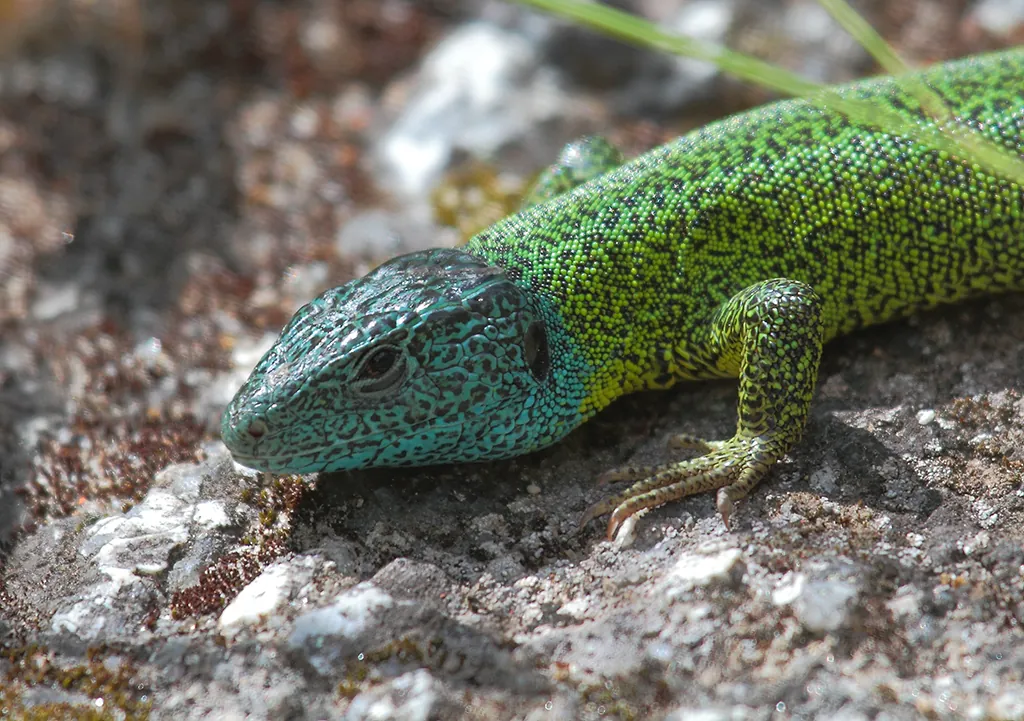
Iberian Emerald Lizard
Lacerta schreiberi
A medium Iberian lacertid with vivid green bodies, seasonally blue-headed males, and a strong preference for cool, humid streamside and woodland-edge habitats.
Overview
The Iberian emerald lizard (Lacerta schreiberi), also called Schreiber's green lizard, is a medium lacertid endemic to the Iberian Peninsula. It favors cooler, more humid habitats than many popular lacertids—especially stream margins, humid shrubland, and woodland edges from near sea level to about 2,100 m. Adults are vividly green with variable black spotting; breeding males develop a striking blue head. IUCN lists the species as Near Threatened because of habitat loss and declining, fragmented populations.
Native Regions
Northwestern and central Spain, Northern and western Portugal, Isolated southern Iberian mountain and coastal populations
Habitats
Humid shrubland and woodland edges, Open deciduous, mixed, and pine woodland, Stream and river margins, Overgrown pasture edges and rocky scrub
Adult Length
About 12-15 inches total length (roughly 4.7-5.3 inches snout-vent); maximum near 16 inches
Adult Weight
Typically about 40-100 grams (roughly 1.5-3.5 ounces); precise published mass ranges are limited
Lifespan
8–12 years
For Beginners
Not ideal as a first reptile. Success depends on a sizable ventilated enclosure, accurate heat and humidity gradients, reliable UVB, insect variety with supplementation, and understanding that this cooler humid-loving lacertid is uncommon in the pet trade and intolerant of stagnant wet setups.
For Experienced Keepers
Experienced keepers can refine outdoor or seasonal housing, managed hibernation for breeding, naturalistic streamside furnishings, and careful pair management while never housing rival adult males together.
Key Points
- › Diurnal Iberian lacertid needing UVB, a warm basking spot, and cooler humid retreats.
- › Primarily insectivorous; occasional fruit is secondary.
- › Solitary or carefully managed male-female pairs only; males are territorial.
Appearance & Behavior
Adults reach about 12 cm (roughly 4.7 inches) snout-vent length and about 38-40 cm (roughly 15-16 inches) total length including the tail. Ground color ranges from gray-brown and yellow-green to bright grass green with black spotting; males usually show finer, denser spotting and a larger head with pronounced femoral pores. Breeding males develop a deep blue head and throat that may fade outside spring. Females often keep larger black dorsal spots; some females remain brownish. Juveniles are coffee-brown for the first few months with yellowish, dark-edged ocelli along the flanks.
Normal Behavior
Diurnal and alert. These lizards bask, forage on the ground and low shrubs, and use rock piles, vegetation, and streamside cover. They are primarily terrestrial but climb readily for basking and insect hunting. When threatened they may flee into dense cover or, in some accounts, into water.
Social Behavior
Adult males are strongly territorial and should not be housed together. Captive male-female pairs can work in large, well-structured enclosures, but gravid females may become aggressive toward keepers or conspecifics around nesting. Multiple females require ample visual barriers and close monitoring. Default to solitary housing unless breeding is intentional.
Warning Signs
Persistent lethargy, refusal to feed after seasonal adjustment, open-mouth breathing, nasal discharge, soft or swollen jaws, incomplete sheds, mites, weight loss, or dull collapsed body condition warrant husbandry review and prompt exotic veterinary care.
Key Points
- › Bright green adults; blue-headed breeding males; patterned brown juveniles.
- › Diurnal baskers and active foragers.
- › Males territorial; solitary housing is the safest default.
Enclosure & Environment
Enclosure Size
Minimum about 36 x 18 x 24 inches (91 x 46 x 61 cm) for one adult. German minimum guidance for a pair is about 28 x 19 x 19 inches based on snout-vent multiples, but keepers of this agile species commonly prefer about 39 x 20 x 28 inches or larger for an adult pair. Floor length matters more than height, though climbing space should still be offered.
Enclosure Type
Glass or similar vivarium with a full screen top or other high-ventilation design; outdoor screen terraria or greenhouses are used successfully in temperate climates when escape-proof and predator-safe.
Substrate
A soil-based mix with leaf litter, patches of sand or gravel, and areas that can be kept slightly moist without becoming muddy works well. Cypress mulch or similar low-dust options are also used. Avoid dusty substrates and deep loose material that risks impaction if heavily ingested.
Heating
Target a basking surface near 95-100°F (about 35-38°C) with cooler ambient zones near 70-80°F (about 21-27°C) so the lizard can choose. Night temperatures of about 60-68°F (15-20°C) are appropriate and beneficial. Use overhead halogen or equivalent basking heat on a thermostat; measure surface and air temperatures with a digital thermometer and infrared gun.
Humidity
Aim for about 55-75% relative humidity with morning and evening misting to mimic natural cycles, while keeping a dry basking area and excellent ventilation. This species prefers moister habitats than arid lacertids, but chronically saturated, stagnant air risks respiratory disease. Provide fresh water always.
Lighting
Provide a roughly 10-14 hour photoperiod with bright visible light and linear T5 HO UVB (keepers report success with 5.0-10.0 strength bulbs mounted above a screen top). Replace UVB on the manufacturer schedule. Outdoor summer housing can supply natural sunlight when shaded retreats exist.
Décor & Enrichment
Offer cork bark hides on warm and cool ends, sturdy branches and rock piles for climbing and basking, live or artificial plants for cover, and a shallow heavy water dish. A moist egg-laying box of damp soil or vermiculite is needed for breeding females.
Cleaning & Maintenance
Spot-clean feces daily, refresh water daily, and deep-clean on a regular schedule with a reptile-safe disinfectant. Monitor temperatures, humidity, feeding, and sheds.
Key Points
- › Adults need a long ventilated footprint with climbing cover—not a small cube.
- › Basking near 95-100°F with cool humid retreats and night drops.
- › Mist for humidity without allowing stagnant wet conditions.
Diet & Nutrition
Primarily insectivorous. Wild animals take invertebrates and may eat small lizards; captive animals also accept soft fruit occasionally. Variety and gut-loading matter more than any single feeder insect.
Food Types
Staples include gut-loaded crickets, dubia roaches, and silkworms, with mealworms and superworms in moderation. Offer other safe invertebrates when available. Soft fruit is an occasional secondary item. Rare pinky mice have been accepted by some adults but should not become routine.
Feeding Schedule
Feed adults about three times weekly (for example Monday, Wednesday, Friday). Feed juveniles daily or six days weekly until growth slows. Hatchlings take tiny crickets and similarly small prey.
Supplements
Dust insects with calcium on most feeds for growing animals and several times weekly for adults when UVB is provided. Use a multivitamin about weekly. Do not stack high-dose vitamin D3 powders on top of strong UVB without veterinary direction.
Hydration
Provide a shallow dish of fresh water at all times. Mist so animals can drink droplets, especially after hibernation when drinking increases. Do not rely on misting alone without a water dish.
Preparation
Gut-load insects for about 24 hours on nutritious greens, vegetables, and fruit. Offer prey no larger than the space between the lizard's eyes. Remove uneaten live insects that could stress or bite the animal overnight.
Common Mistakes
Avoid under-sized enclosures, arid-only setups, no UVB, oversized prey, all-mealworm diets, over-misting into stagnant wet substrate, housing rival males together, and skipping calcium/UVB until metabolic bone disease appears.
Key Points
- › Insectivore with occasional fruit; gut-load and dust feeders.
- › Adults about three times weekly; juveniles more often.
- › Always offer drinking water plus light misting.
Handling
Captive-raised individuals can become relatively calm and interactive for lacertids, but they remain fast, alert lizards that may flee or drop the tail if grabbed. Routine handling is possible with care; it is not a cuddly pet species.
Techniques
Approach slowly, scoop from below with full body support, and keep sessions short. Prefer letting the lizard walk onto a hand rather than pinning. Wash hands before and after handling.
Do's & Don'ts
Do not grab the tail, chase the animal around the enclosure, or restrain tightly. Avoid handling during sheds, right after feeding, or when a gravid female is nesting. Never handle rival males in the same session in a way that risks fights if returned together.
Taming
Short, calm sessions and food-from-tongs interactions build tolerance over weeks to months. Expect more flightiness from wild-caught or rarely handled animals.
Stress Signals
Frantic flight, open-mouth threat, biting, dark stress coloration, and especially tail autotomy (voluntary tail drop) mean stop immediately.
Key Points
- › Handleable with patience; not a high-handling species.
- › Support the body; never grab the tail.
- › Stop at flight, bite, or tail-drop risk.
Health & Wellness
Common Health Issues
Metabolic bone disease
Description
Calcium and UVB imbalance leading to weakened bone and neuromuscular problems in growing or breeding lizards.
Symptoms
Soft or swollen jaws, tremors, limb deformities, lethargy, difficulty climbing or feeding.
Prevention
Provide appropriate UVB, a measured basking gradient, gut-loaded insects, and regular calcium dusting.
Treatment
Contact a qualified exotic veterinarian promptly; supportive husbandry corrections alone are not a substitute for veterinary care.
Respiratory infection
Description
Often associated with chronically cool, stagnant, or overly wet conditions without a dry retreat, or with poor ventilation.
Symptoms
Open-mouth breathing, wheezing, bubbles or discharge from the nose or mouth, lethargy, appetite loss.
Prevention
Maintain a proper heat gradient, dry basking zone, humidity cycles with strong airflow, and clean water.
Treatment
Seek exotic veterinary care; adjust temperatures, ventilation, and humidity only as supportive measures under guidance.
External parasites (mites/ticks)
Description
Especially reported in densely furnished or outdoor setups; mites can stress juveniles.
Symptoms
Visible mites, excessive soaking, restless rubbing, anemia or poor thriving in heavy infestations.
Prevention
Quarantine new animals, keep furnishings clean, and avoid introducing wild-caught décor without sterilization.
Treatment
Consult an exotic veterinarian for safe parasite treatment; do not use dog/cat products without veterinary direction.
Preventative Care
Annual or biannual exams with a reptile-experienced veterinarian when available, quarantine for new animals, weight and feeding logs, and consistent temperature, UVB, and diet husbandry. This content is educational husbandry guidance, not a diagnosis.
Emergency Signs — seek vet care immediately
Open-mouth breathing, collapse, severe trauma, uncontrolled bleeding, inability to move limbs, prolonged egg-binding signs, or complete food refusal with rapid weight loss require urgent exotic veterinary care.
Key Points
- › UVB, calcium, and a real heat gradient prevent many bone problems.
- › Avoid stagnant wet cold setups to reduce respiratory risk.
- › Quarantine and veterinary care matter for parasites and emergencies.
Breeding
Oviparous. In captivity, successful breeding is strongly linked to a cool hibernation period followed by spring warming, long photoperiods, and abundant food. Wild clutch averages are often about 11-18 eggs; captive clutches commonly range about 6-24 eggs once per year in outdoor setups.
Preparation
Only breed healthy, well-conditioned adults after veterinary clearance if possible. Provide a deep moist nesting site. Plan for solitary or carefully monitored pair housing; separate males after breeding if aggression appears. Hibernation around 50°F (about 10°C) for several cooler months is commonly used by breeders after a fasting period.
Breeding Process
Males court by following and nudging females after emergence. Mating usually occurs in spring. Females typically lay one clutch about a month after copulation and may defend the nest site. Remove eggs promptly for incubation.
Egg Care
Incubate on a moist medium such as perlite or vermiculite with good humidity and ventilation. Reported successful ranges include about 69-79°F with a night drop (~60 days) and steadier ~82°F (~37-50 days). Full reported incubation spans about 37-65 days. Mark the top of eggs and avoid rotating them.
Hatchling Care
House hatchlings in well-ventilated setups with UVB, a gentle heat gradient, and tiny gut-loaded insects daily. Watch for aggression and separated slower growers. Some keepers raise juveniles drier than adults to reduce mite risk while still providing drinking water.
Key Points
- › Spring breeders after cool hibernation.
- › Clutches often about 6-24 eggs; incubate roughly 37-65 days.
- › Feed hatchlings frequently with tiny prey and UVB.