
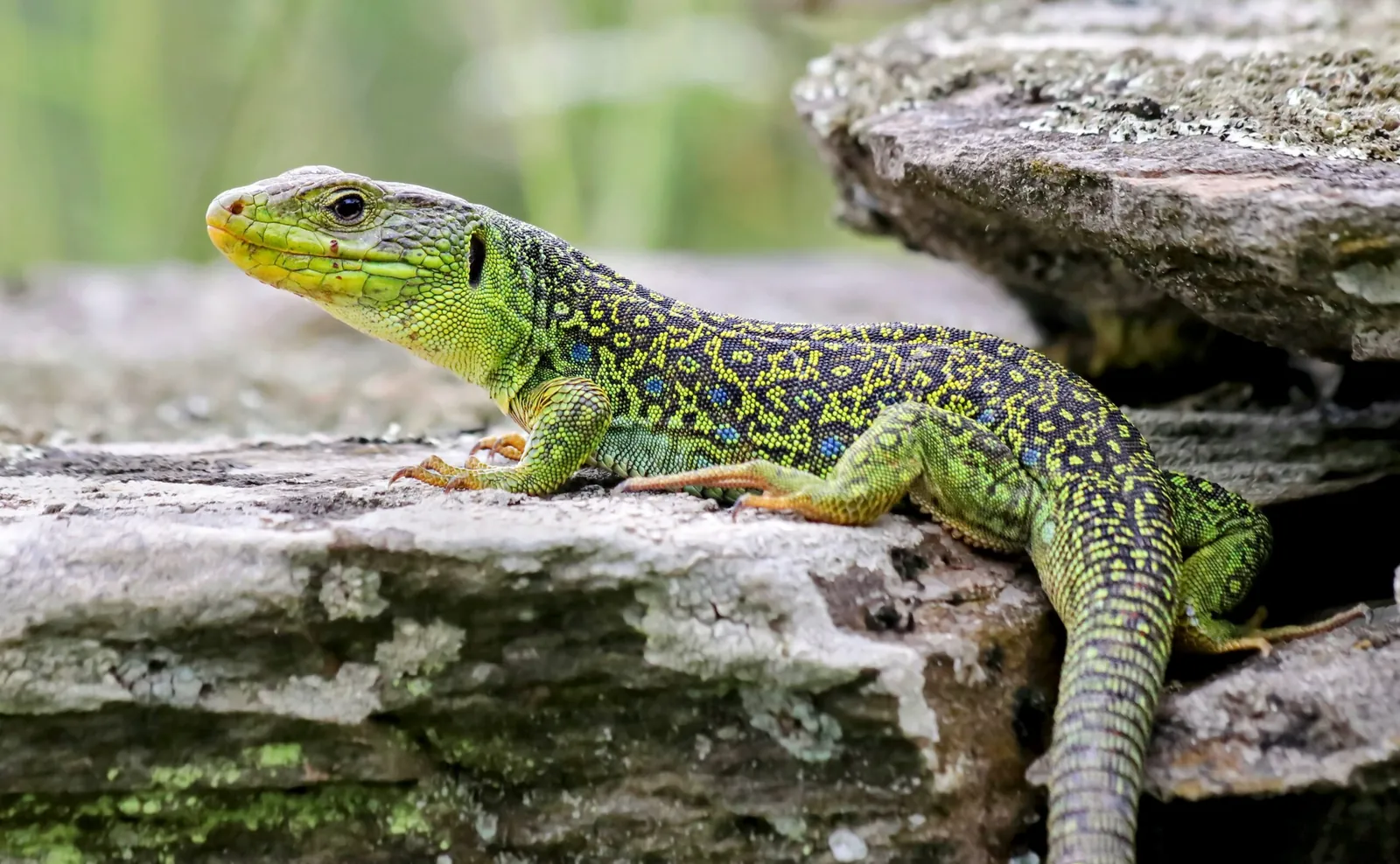
Ocellated Lizard
Timon lepidus
A large, diurnal European lacertid from the Iberian Peninsula and nearby southwestern Europe, known for green to olive bodies, blue flank ocelli, and a need for spacious, brightly lit enclosures.
Overview
The ocellated lizard, also called the jeweled or eyed lizard (Timon lepidus), is one of Europe's largest lacertids. It is endemic to southwestern Europe—mainly the Iberian Peninsula, with populations in southern and western France, extreme northwestern Italy, and Andorra. Adults are powerful, fast, and visually striking, with green to olive bodies and blue eye-like flank spots in many individuals. In captivity it needs a large, dry, brightly lit terrestrial enclosure, strong overhead heat and UVB, and a varied insect-based diet. North African eyed lizards formerly grouped with this species are now treated as separate taxa (Timon pater and Timon tangitanus).
Native Regions
Iberian Peninsula (Spain and Portugal), Southern and western France, Extreme northwestern Italy, Andorra
Habitats
Mediterranean scrub and open shrubland, Open woodland edges and olive groves, Sunny grassland, meadows, and rocky slopes, Stone walls, terraces, and rural agricultural edges
Adult Length
Typically about 18-28 inches (45-70 cm) total length; large males can approach about 30-36 inches
Adult Weight
Often about 75-200 grams; large males may approach about 300-400 grams
Lifespan
10–20 years
For Beginners
Not a first lizard. Adults need far more floor space than a tabletop tank, strong heat and UVB equipment, live insects, and a keeper who accepts that many individuals stay nervous and prefer observation over frequent handling. Choose a calmer, smaller species if space or experience is limited.
For Experienced Keepers
Rewarding for keepers who can provide a large horizontal vivarium (ideally about 6 x 2 x 2 feet or larger), measured UV gradients, deep diggable substrate, and optional seasonal cooling or outdoor housing where climate and local law allow. Breeding requires spare housing and careful management of clutch frequency to protect females.
Key Points
- › Large diurnal lacertid from open Mediterranean habitats in southwestern Europe.
- › Needs a spacious dry enclosure, intense light, a hot basking zone, and UVB.
- › Primarily insectivorous; best housed singly outside managed breeding.
Appearance & Behavior
A robust lacertid with a deep head and body, strong limbs, and a long tail that often makes up much of total length. Typical adults are about 18-28 inches long; exceptional large males can approach about 30-36 inches. Coloration is commonly bright green to olive with black speckles and conspicuous blue ocelli along the flanks; some animals are duller gray-brown. Males usually have broader heads and more vivid blue spotting than females.
Normal Behavior
Strictly diurnal and heliothermic: they bask openly, then hunt, dig, climb low structure, and retreat to burrows, rock crevices, or hides. They are alert and fast. In nature they often use mammal burrows and complex cover rather than dense humid forest. Captive animals may nose-rub if space, cover, or visibility is poor.
Social Behavior
Generally solitary in captivity. Adult males can fight, and mixed pairs can produce chronic stress or excessive breeding. Keep adults singly unless there is a deliberate breeding plan with immediate separation housing available. Do not treat wild aggregations at burrows as a reason to cohabit pets.
Warning Signs
Persistent lethargy, sunken eyes, soft or swollen jaw or limbs, tremors, chronic appetite loss, retained shed on toes or tail tip, nose abrasions from glass-surfing, abnormal droppings, open-mouth breathing, or unexplained weight loss warrant husbandry review and a reptile veterinarian.
Key Points
- › Green to olive lizard with blue flank ocelli; males larger-headed.
- › Active by day: basks, hunts, digs, and uses secure retreats.
- › House alone except for carefully managed breeding.
Enclosure & Environment
Enclosure Size
Practical minimum for one adult about 72 x 24 x 24 inches (180 x 60 x 60 cm). Some commercial care sheets cite 48 x 24 x 24 inches as an absolute floor, but this active species benefits strongly from more floor area. Juveniles can start smaller and must be upgraded as they grow.
Enclosure Type
Wooden, PVC, or well-ventilated glass vivarium with a secure lid or front doors. Front-opening setups reduce chasing. Mesh ventilation is important for a mostly dry climate.
Substrate
A deep soil, sand, and clay-style mix that allows digging works well for healthy adults. Aim for several inches of depth. Paper towel or similar simple substrates are safer for quarantine or sick animals. Avoid calcium sand and aromatic wood products.
Heating
Create a hot overhead basking surface of about 100-110°F (38-43°C), warm-zone air near 82-90°F, and a cool end about 68-77°F by day, so overall daytime ambient air spans roughly 75-85°F across the enclosure. At night, allow a drop to about 60-70°F (16-21°C) for routine maintenance; turn visible heat and light off. Measure surface and air temperatures separately.
Humidity
Keep the enclosure mostly dry and well ventilated, with ambient relative humidity commonly about 40-60%. Provide a moisture gradient: one hide or deeper substrate pocket lightly damp for shedding, while the rest stays dry. Avoid constantly wet substrate and poor airflow.
Lighting
Bright daytime lighting plus high-output UVB are required. Treat the species as a Ferguson Zone 3-4 heliotherm: aim for roughly UVI 3-5 at the basking height with shaded retreats near zero. A T5 HO desert-style UVB tube over the warm end plus separate halogen basking lamps is a common approach. Use about a 10-12 hour photoperiod, adjusted seasonally if a winter rest is planned. No visible night lights. UVB does not pass through glass.
Décor & Enrichment
Include a large flat basking stone, hides on warm and cool ends, cork tubes or bark, stable rock piles, low branches or roots, and visual cover. Block constant side visibility if the animal nose-rubs. A moist nest box is needed for breeding females.
Cleaning & Maintenance
Spot-clean feces and soiled substrate daily, refresh water daily, and deep-clean about monthly with a reptile-safe disinfectant. Wash hands before and after contact because reptiles can carry Salmonella.
Key Points
- › Large dry terrestrial vivarium with deep substrate and multiple hides.
- › Strong overhead heat, bright light, and measured UVB are essential.
- › Prefer roughly 6 x 2 x 2 feet or larger for one adult.
Diet & Nutrition
Primarily insectivorous to omnivorous. Most captive meals should be varied feeder insects; plant matter and rare vertebrate treats are secondary. Wild animals take many arthropods and may also eat fruit, small vertebrates, or carrion depending on opportunity.
Food Types
Staples include gut-loaded crickets, locusts, and feeder roaches, plus soft-bodied insects such as silkworms and black soldier fly larvae. Occasional greens, flowers, berries, or other fruit may be accepted. Large adults may take rare pinky mice; do not make rodents a staple. Avoid wild-caught insects from pesticide areas and oversized prey.
Feeding Schedule
Feed juveniles daily. Feed adults several times per week—commonly every other day—adjusting portions to keep a healthy body condition without obesity.
Supplements
Dust insects with phosphorus-free calcium on most feeds for juveniles, less often for adults with correct UVB. Use a reptile multivitamin about weekly or per product guidance. Supplements do not replace UVB lighting.
Hydration
Provide a heavy shallow water dish at all times and refresh it daily. Light morning misting or a damp retreat helps some individuals drink and shed; do not soak the whole enclosure.
Preparation
Gut-load insects for about 24 hours before feeding. Prey should be no wider than the lizard's head. Offer food in a way that limits substrate ingestion when possible.
Common Mistakes
Enclosure too small or too dim; basking surface too cool; ambient humidity kept chronically high; cohabiting adults; feeding only one insect type; skipping calcium or UVB; offering prey that is too large.
Key Points
- › Varied gut-loaded insects are the core diet.
- › Plant matter is occasional; rodents are rare treats at most.
- › Calcium dusting plus UVB supports bone health.
Handling
Many ocellated lizards can learn to tolerate careful handling, and some become quite tame, but they are not inherently cuddly pets. Treat handling as optional enrichment, not a daily requirement.
Techniques
Start with tong-feeding and presence near the enclosure. Approach from the side, scoop from below rather than grabbing from above, and support the full body and feet. Keep early sessions short and end while the lizard is calm.
Do's & Don'ts
Do not chase, restrain tightly, or grab the tail. Avoid housing that forces constant handling for maintenance. Separate animals before introducing handling practice if cohabitation is attempted for breeding.
Taming
Patience and predictable routines work better than frequent forced contact. Hand-feeding builds trust for some individuals; others remain observation animals and are still rewarding when husbandry is excellent.
Stress Signals
Flight attempts, frantic glass-surfing, open-mouth threat displays, biting, or tail autotomy mean handling should stop. Repeated stress can reduce appetite and increase injury risk.
Key Points
- › Can become handleable with patience, but many stay nervous.
- › Scoop from the side and support the whole body.
- › Stop if the lizard flees, bites, or drops its tail.
Health & Wellness
Common Health Issues
Metabolic bone disease
Description
Calcium imbalance and inadequate UVB or diet commonly cause weakened bones and neuromuscular signs in growing lacertids.
Symptoms
Soft or swollen jaw, tremors, weak limbs, spinal deformities, lethargy, or reluctance to climb and bask.
Prevention
Provide measured UVB, a hot basking zone, gut-loaded insects, and appropriate calcium supplementation.
Treatment
Contact a qualified exotic veterinarian promptly; husbandry correction alone is not a substitute for veterinary assessment of advanced cases.
Stress injuries and nose rub
Description
Escape attempts in undersized, barren, or overly visible enclosures can abrade the snout and damage scales.
Symptoms
Raw or scabbed nose, worn rostral scales, frantic pacing, or glass-surfing.
Prevention
Use adequate space, multiple hides, visual barriers, and calm maintenance routines.
Treatment
Improve husbandry immediately and seek veterinary care for open wounds or secondary infection.
Retained shed and dehydration issues
Description
Chronically arid setups without a humid retreat, or poor hydration, can leave shed stuck on digits and tail tips.
Symptoms
Constricted toes or tail tip, incomplete sheds, dull skin, or sunken eyes.
Prevention
Offer a damp hide, fresh water, and correct temperatures so the lizard can thermoregulate and drink.
Treatment
Correct humidity microclimates and consult a veterinarian if digits appear swollen, necrotic, or constricted.
Respiratory and husbandry-linked illness
Description
Cool, wet, poorly ventilated enclosures or chronic stress can contribute to respiratory and systemic illness.
Symptoms
Open-mouth breathing, bubbles or discharge from the nose, unusual wheezing sounds, lethargy, or appetite loss.
Prevention
Keep the enclosure mostly dry with good airflow, correct temperatures, and minimal forced handling.
Treatment
Seek prompt exotic veterinary care; do not attempt antibiotic treatment without veterinary guidance.
Preventative Care
Maintain temperature, UVB, and diet logs; weigh periodically; quarantine new animals; and schedule wellness exams with a reptile-experienced veterinarian. Educational husbandry guidance is not a diagnosis.
Emergency Signs — seek vet care immediately
Collapse, seizures, severe trauma, uncontrolled bleeding, open-mouth breathing, prolonged refusal to eat with weight loss, or sudden extreme lethargy require urgent veterinary attention.
Key Points
- › Most problems trace to space, heat, UVB, diet, or chronic stress.
- › Watch for soft bones, nose rub, retained shed, and breathing changes.
- › Use a qualified exotic veterinarian for illness and emergencies.
Breeding
Oviparous. In nature, mating is typically in late spring, with eggs laid in late spring to summer. Captive pairs can overproduce clutches if left together indoors, which depletes females.
Preparation
Only breed healthy, mature animals with proven captive origin where required by law. Provide spare housing, a moist nesting area of diggable substrate, and a plan for incubating and rearing hatchlings. In Europe the species is protected; keep captive-bred stock and follow local rules.
Breeding Process
After mating, females dig test burrows and deposit a clutch of roughly 5-22 eggs (commonly around 8-15). Indoors, limit repeated breeding by separating the pair after one or two clutches.
Egg Care
Incubate eggs on a moist incubation medium near about 82-86°F (28-30°C). Expect roughly 8-14 weeks to hatch; cooler incubation takes longer. Reports of hatch timing vary, so monitor eggs rather than relying on a single calendar date.
Hatchling Care
Hatchlings usually feed within about a day on appropriately small insects with calcium support and UVB. Keep them separate from adults, which may cannibalize young. Upgrade housing as they grow rapidly.
Key Points
- › Spring-summer egg layers with sizable clutches.
- › Separate pairs to prevent excessive captive breeding.
- › Incubate moist eggs for roughly 2-3.5 months.