
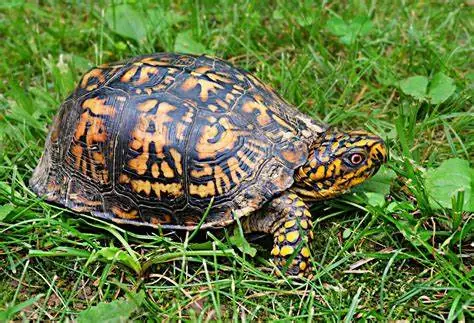
Eastern Box Turtle
Terrapene carolina carolina
A small terrestrial woodland turtle of eastern North America with a high-domed shell and a hinged plastron that can close into a protective box; long-lived, omnivorous, and best kept solitary in a spacious, humid setup with UVB and a shallow soak.
Overview
The eastern box turtle (Terrapene carolina carolina) is a small terrestrial emydid turtle of eastern North America, named for the hinged plastron that lets it close its shell into a protective box. Adults usually reach about 4.5-6 inches in carapace length, with colorful yellow, orange, or olive patterning on a dark shell. They are primarily woodland and edge animals that forage in leaf litter, seek moist microhabitats in hot weather, and may live for decades. IUCN lists the broader species Terrapene carolina as Vulnerable because of habitat loss, road mortality, and collection pressure.
Native Regions
Eastern United States from southern Maine and New York south to Georgia and northern Florida, West to Michigan, Illinois, Tennessee, and Alabama, Historically southern Ontario, Canada (now largely extirpated)
Habitats
Hardwood and mixed forests, Forest edges and early-successional clearings, Marshy meadows, floodplains, and wetland margins, Fields and pastures near woodland cover
Adult Length
Typically about 4.5-6 inches straight carapace length; large adults may approach about 8 inches
Adult Weight
Typically about 250-600 grams (about 0.5-1.3 pounds); large adults may approach about 620 grams
Lifespan
30–50 years
For Beginners
Not recommended for beginners. Adults need a large humid footprint (often better outdoors), reliable UVB and heat gradients, a varied omnivorous diet, seasonal husbandry including possible brumation planning, and a multi-decade commitment. Wild-caught animals harm declining populations and may be illegal to keep or sell where you live—prefer captive-bred animals and check local laws.
For Experienced Keepers
Experienced keepers can refine large outdoor predator-proof pens, measured UVI targets around 3-4 at the basking site, bioactive woodland setups, seasonal photoperiod and controlled brumation for healthy northern-locality animals, and carefully managed breeding with nest sites and hatchling humidity.
Key Points
- › Terrestrial, diurnal woodland turtle with a hinged, closable shell.
- › Needs large floor space, moist substrate, UVB, and a shallow soak.
- › Omnivorous and long-lived; best housed alone.
Appearance & Behavior
Adults typically measure about 4.5-6 inches (11-15 cm) straight carapace length; exceptional individuals approach about 8 inches (20 cm). Virginia population data report adult body masses commonly about 250-620 grams. The carapace is high-domed with variable yellow, orange, or reddish markings on a brown to black background. A single hinge on the plastron allows complete closure. Males often have a concave rear plastron, thicker tails, and sometimes redder irises; females often have a flatter plastron and browner eyes, though eye color is not always reliable.
Normal Behavior
Diurnal and mostly terrestrial. Activity increases in humid weather and after rain. In hot, dry periods they seek shade, damp soil, leaf litter, or shallow water. They forage widely for invertebrates, fruit, fungi, and plant matter. When threatened they usually withdraw into the shell rather than flee.
Social Behavior
Wild individuals may share overlapping home ranges, but captive eastern box turtles are best housed singly. Cohabitation in limited space risks bullying, breeding stress, injury, and disease transmission. Group housing should be reserved for large outdoor pens managed by experienced keepers who can separate animals immediately.
Warning Signs
Persistent lethargy, refusal to eat across multiple days when warm and hydrated, swollen or closed eyes, nasal bubbles or discharge, open-mouth breathing, soft shell, foul-smelling shell lesions, or sudden weight loss warrant husbandry review and prompt exotic-veterinary care.
Key Points
- › High-domed shell with a hinged plastron that closes tightly.
- › Active by day, especially in humid weather.
- › House alone unless a very large, carefully managed pen is available.
Enclosure & Environment
Enclosure Size
Modern indoor starting guidance for one adult is about 6.5 x 3.5 x 2 feet (78 x 42 x 24 inches) of usable footprint, or larger. Tree of Life Exotic Pet Medical Center cites about 4 x 2 feet indoors and at least 4 x 4 feet outdoors as veterinary minimums; larger is strongly preferred. Juveniles may start smaller but should be upgraded as they grow. Outdoor walls should be smooth, at least about 2 feet tall, buried to deter digging, and covered against predators.
Enclosure Type
A secure outdoor predator-proof pen with shade, sun, and dig-proof walls is preferred where climate allows. Indoors, use a large PVC, sealed wood, or custom terrestrial enclosure that holds humidity without becoming stagnant; avoid undersized glass aquaria as the long-term adult home.
Substrate
Use a deep, moisture-retentive naturalistic mix such as organic topsoil with coco fiber or cypress mulch and sphagnum, topped with leaf litter. Aim for at least about 4 inches indoors and deeper outdoors so the turtle can dig. Avoid gravel, sand-only floors, cedar, pine, and aspen shavings.
Heating
Create a basking surface about 84-90°F (29-32°C) and a cool zone about 70-75°F (21-24°C), with daytime ambient air spanning roughly 70-80°F across the enclosure. Use overhead halogen or similar heat rather than under-tank heat. Allow a natural nighttime drop into about 60-70°F for indoor setups; outdoor animals may tolerate cooler nights when they can bury safely. Do not force unsupervised deep winter chilling without a veterinary brumation plan.
Humidity
Target about 60-80% average relative humidity with moist deep substrate and a humid hide on the cool end. Daytime humidity should not chronically fall below about 50%. Mist substrate as needed, keep leaf litter damp but not swampy, and maintain ventilation so the air is not stagnant. Chronically dry housing contributes to shell and shedding problems.
Lighting
Provide a daytime photoperiod of roughly 10-14 hours seasonally. Indoors, use a linear mid-strength UVB lamp (for example Arcadia T5 HO Forest ~6% or Zoo Med T5 HO ReptiSun 5.0) over the warm end so the basking zone reaches about UVI 3-4 at shell height, with shade available. Supplement with bright daylight-spectrum LED lighting. UVB does not pass through glass or plastic. Outdoor turtles in unfiltered sunlight do not need artificial UVB when outdoors. Replace UVB bulbs on the manufacturer schedule even if they still look bright.
Décor & Enrichment
Offer at least two hides or burrows, hollow logs, low branches or mounds, flat stones, dense leaf litter, edible plants where appropriate, and a shallow soak dish no deeper than about the turtle's elbow height. Arrange cover so the turtle can move fully out of the basking and UV zone.
Cleaning & Maintenance
Spot-clean feces and soiled substrate daily, refresh soak water daily, and scrub water dishes with a reptile-safe disinfectant regularly. Deep-clean and replace indoor substrate every few months depending on bioload. Wash hands after contact because reptiles can carry Salmonella.
Key Points
- › Prefer a large outdoor pen; indoors start near 6.5 x 3.5 x 2 feet.
- › Keep a warm basking zone, cool retreat, UVB, and moist substrate.
- › Provide a shallow soak and a humid hide.
Diet & Nutrition
Eastern box turtles are opportunistic omnivores. Captive diets should offer roughly equal animal and plant matter for this subspecies, with greater protein emphasis for juveniles and careful portion control for adults to limit obesity.
Food Types
Staple animal foods include earthworms, captive-bred snails, gut-loaded crickets, feeder roaches, black soldier fly larvae, and similar invertebrates. Staple plants include dark leafy greens, squash, edible mushrooms, and other vegetables. Complete commercial box turtle or tortoise diets can form part of the mix. Fruit should stay occasional. Avoid wild-caught insects that may carry pesticides, and avoid iceberg lettuce, onions, and garlic.
Feeding Schedule
Feed growing juveniles daily. Offer adults a varied meal about every other day or several times per week, adjusting to body condition and activity. Feed earlier in the day while the turtle is warm.
Supplements
Indoor turtles usually need phosphorus-free calcium on most insect feeds when young, plus a multivitamin that includes preformed vitamin A about once or twice weekly. Provide a cuttlebone for self-selection. With measured UVB, avoid stacking multiple high-D3 products without veterinary advice.
Hydration
Always provide a large shallow dish of clean water for drinking and soaking. Replace water daily. Periodic supervised warm soaks can support hydration, especially in drier indoor rooms, but do not replace correct ambient humidity and moist substrate.
Preparation
Wash produce and chop it into manageable pieces. Gut-load feeder insects before offering. Present food on a flat dish or tray to reduce substrate ingestion. Remove leftovers the same day.
Common Mistakes
Relying only on fruit or pellets, skipping animal protein for juveniles, keeping the enclosure too dry, feeding on loose substrate, omitting UVB or calcium support, and overfeeding adults until they become obese.
Key Points
- › Omnivore: roughly half invertebrates and half plants for easterns.
- › Feed juveniles daily and adults every other day or several times weekly.
- › Use calcium, vitamin A-containing multivitamins, and a cuttlebone indoors.
Handling
Eastern box turtles tolerate brief, careful handling for health checks and enclosure moves, but they do not benefit from frequent carrying or household roaming. Prefer interaction through feeding and enclosure enrichment.
Techniques
Approach from the side or below rather than grabbing from above. Support the entire shell with two hands so the body and limbs are secure. Keep sessions short so the turtle does not chill. Always wash hands before and after contact.
Do's & Don'ts
Do not flip the turtle onto its back, drill the shell, tether it, or lift by a limb or tail. Do not allow unsupervised roaming where it can fall, overheat, or encounter pets. Never collect wild turtles for pets.
Taming
Allow new arrivals a quiet settling period with correct heat, humidity, and food before routine handling. Many individuals remain reserved; trust building is better done with predictable feeding than with frequent picking up.
Stress Signals
Full withdrawal into the shell, hissing, struggling, gaping, or repeated attempts to escape mean stop handling and return the turtle to its enclosure.
Key Points
- › Handle briefly and support the whole shell with two hands.
- › Prefer enrichment and feeding over frequent carrying.
- › Wash hands; reptiles can carry Salmonella.
Health & Wellness
Common Health Issues
Respiratory infection
Description
Bacterial or other respiratory disease often linked to chronic chill, poor ventilation, or inappropriate humidity.
Symptoms
Nasal discharge or bubbles, wheezing, open-mouth breathing, lethargy, and appetite loss.
Prevention
Maintain a correct temperature gradient, avoid stagnant cold damp air, and keep humidity in the target range without chilling the turtle.
Treatment
Contact a qualified exotic veterinarian promptly; antibiotics or other therapy must be prescribed after examination. Husbandry correction alone is not a substitute for veterinary care.
Shell rot and shell injury
Description
Bacterial or fungal infection of the shell, or trauma from falls, bites, or dirty wet conditions.
Symptoms
Soft spots, pits, discoloration, foul odor, hemorrhage, or exposed bone.
Prevention
Keep substrate moist but not filthy, provide a dry basking option, prevent falls, and house turtles singly unless space is ample.
Treatment
Seek exotic veterinary care for cleaning, diagnostics, and medications. Do not scrape or treat deep lesions at home without guidance.
Hypovitaminosis A and related eye disease
Description
Vitamin A deficiency from an unbalanced diet, especially in indoor turtles without appropriate supplementation.
Symptoms
Swollen or closed eyelids, ocular discharge, secondary respiratory signs, and lethargy.
Prevention
Feed a varied diet and use a multivitamin with preformed vitamin A for indoor animals as directed.
Treatment
Veterinary assessment is required; vitamin A therapy and treatment of secondary infections must be supervised by a clinician.
Metabolic bone disease
Description
Calcium or vitamin D3 imbalance from missing UVB, inadequate calcium, or poor diet, leading to soft shell and skeletal weakness.
Symptoms
Soft or deformed shell, weakness, tremors, fractures, or reluctance to walk.
Prevention
Provide measured UVB, calcium support, and a balanced omnivorous diet with a cuttlebone available.
Treatment
See an exotic veterinarian for diagnostics and a corrected husbandry and nutrition plan; do not megadose supplements without guidance.
Preventative Care
Weigh regularly, monitor appetite and shell condition, maintain heat, humidity, UVB, and cleanliness, quarantine new animals, and schedule wellness exams with a reptile-experienced veterinarian. This content is educational husbandry guidance, not a diagnosis.
Emergency Signs — seek vet care immediately
Open-mouth breathing, severe lethargy, collapse, inability to right itself, bleeding shell trauma, rapid swelling of the eyes, or complete refusal to eat while warm and otherwise husbanded correctly require urgent exotic-veterinary care.
Key Points
- › Most problems trace to temperature, humidity, UVB, diet, or hygiene failures.
- › Respiratory disease, shell rot, vitamin A deficiency, and metabolic bone disease are common risks.
- › Use a qualified exotic veterinarian for illness and emergencies.
Breeding
Eastern box turtles are oviparous with temperature-dependent sex determination. Captive breeding should only be attempted by keepers prepared for long-term hatchling care and local wildlife regulations.
Preparation
Breed only healthy, mature animals with known locality or captive lineage when possible. Provide a nesting area of soft, moist soil. Separate sexes outside planned breeding if aggression or persistent mounting appears. Confirm legal status before acquiring or transferring animals.
Breeding Process
Mating can occur from spring through fall. Nesting is most often May through July. Females commonly lay about 3-8 eggs (sometimes 1-11), often around 4-5, and may produce more than one clutch in warmer parts of the range. Females can store sperm for multiple years.
Egg Care
Incubate eggs at roughly 80-85°F (27-29°C) with appropriate humidity; incubation commonly lasts about 60-90 days. Cooler incubation tends to produce more males and warmer incubation more females. Some hatchlings overwinter in the nest in nature.
Hatchling Care
Hatchlings need high humidity, shallow water they can exit easily, UVB, a thermal gradient, and a protein-rich omnivorous diet. Protect them from predators and larger turtles. Growth is slow; plan for years of dedicated care.
Key Points
- › Mature around 5-10 years; nesting mainly late spring to summer.
- › Typical clutches about 3-8 eggs; incubation about 60-90 days.
- › Hatchlings need humid, secure setups and a long-term plan.