
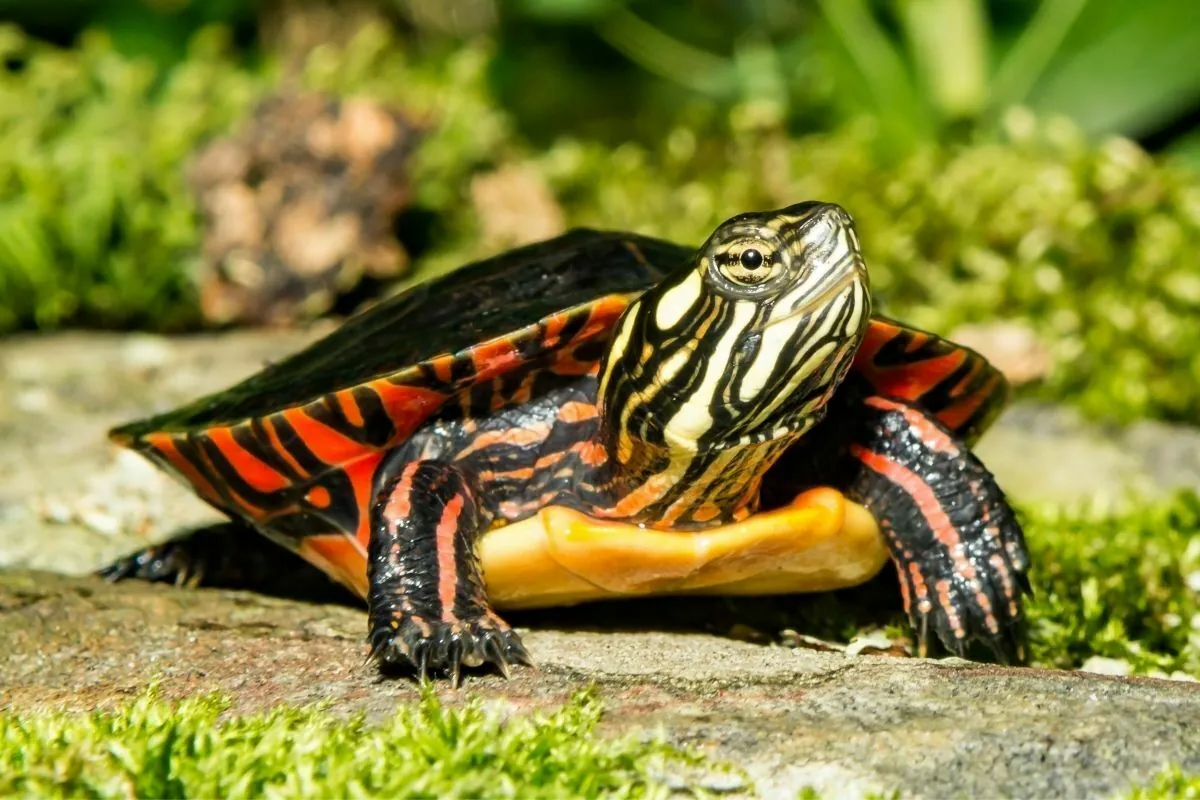
Painted Turtle
Chrysemys picta
North America's most widespread native freshwater turtle, with a smooth dark shell edged in red or orange and yellow or red stripes on the skin.
Overview
The painted turtle (Chrysemys picta) is the most widespread native freshwater turtle in North America. Three subspecies are widely recognized—eastern (C. p. picta), midland (C. p. marginata), and western (C. p. bellii)—while the southern painted turtle is often treated as a separate species (C. dorsalis). These semi-aquatic turtles live in still or slow freshwater with soft bottoms, vegetation, and places to haul out and bask.
Native Regions
Southern Canada, United States (coast to coast in the north and much of the east and Midwest), Northern Mexico
Habitats
Ponds and lakes, Marshes, bogs, and swamps, Slow-flowing rivers and streams, Shallow wetlands with soft bottoms and basking sites
Adult Length
About 4-10 inches carapace (males smaller; western females largest)
Adult Weight
Roughly 200-600 grams typical; large western females may be heavier
Lifespan
25–40 years
For Beginners
Often marketed as an easy first turtle, but adult housing, canister filtration, water cycling, and UVB make this a poor impulse purchase. New keepers should master aquarium nitrogen cycling and budget for a large adult enclosure before acquiring one.
For Experienced Keepers
Experienced keepers can refine outdoor pond housing, seasonal photoperiod, nesting provisions for breeding females, and long-term water chemistry monitoring. Captive-bred animals are preferred over wild-caught.
Key Points
- › Diurnal, primarily aquatic North American pond turtle
- › Needs a large filtered aquatic setup with a dry basking dock and UVB
- › Long-lived omnivore; water-quality maintenance is the main care burden
Appearance & Behavior
A medium freshwater turtle with a smooth, relatively flat oval carapace that is olive to black, often with red or orange markings on the marginal scutes. The skin is dark with yellow and/or red stripes on the head, neck, and limbs. Plastron pattern varies by subspecies: eastern turtles often have a plain yellow plastron, midland turtles a central dark blotch, and western turtles an ornate dark network on a red-orange background. Adult carapace length is commonly about 4-10 inches; males are smaller with elongated foreclaws and longer, thicker tails, while females are larger.
Normal Behavior
Diurnal and strongly aquatic. They swim, forage underwater, and haul out to bask on logs, rocks, or docks. They typically rest underwater or on a submerged object at night. In cooler climates they brumate in shallow water bodies through winter.
Social Behavior
Wild painted turtles often bask in groups, but indoor tanks rarely offer enough space to escape bullying. House one turtle per typical indoor enclosure unless you can provide a very large pond-style setup with multiple basking sites and visual barriers.
Warning Signs
Persistent lethargy, refusal to eat, swollen or sunken eyes, nasal bubbles or open-mouth breathing, listing or inability to submerge, shell soft spots or foul odor, excessive hiding from the water, or sudden aggression during basking contests may signal husbandry or health problems.
Key Points
- › Smooth dark shell with colorful red and yellow markings
- › Active swimmers that bask frequently during the day
- › Best kept singly in most indoor aquariums
Enclosure & Environment
Enclosure Size
A common rule of thumb is about 10 gallons of water per inch of shell length, so a large adult often needs roughly 75-100+ gallons of water. The staged minimum footprint is about 72 by 24 by 24 inches; bigger is better for swimming and water quality.
Enclosure Type
Large aquarium, stock tank, Waterland-style tub, or secure outdoor pond with predator protection.
Substrate
Bare-bottom tanks are easiest to clean. If substrate is used, choose particles too large to swallow or fine sand that can pass if ingested; avoid small gravel that can cause impaction.
Heating
Create a dry basking surface around 90-95°F with a halogen flood lamp measured by infrared thermometer. Keep water near 75-80°F for most indoor adults with a properly rated, protected submersible heater; some keepers run adult water a few degrees cooler. Turn heat lamps off at night and allow a mild overnight drop. Avoid hot rocks.
Humidity
Air humidity above the tank is not the main care metric. Focus on clean, dechlorinated water, zero ammonia and nitrite, and regular partial water changes. The app humidity field is only a coarse indoor-air placeholder.
Lighting
Provide bright daytime lighting and a quality T5 HO UVB lamp over the basking area for about 10-14 hours seasonally (shorter in winter, longer in summer). Replace UVB bulbs on the manufacturer's schedule because output declines before the bulb looks dead. Outdoor sun during warm weather can replace artificial UVB when housing is safe and supervised.
Décor & Enrichment
Include a stable dry basking platform large enough for the whole turtle, underwater cover that cannot trap the animal, smooth rocks or wood, and live or artificial plants. Multiple basking options help if more than one turtle is ever housed together.
Cleaning & Maintenance
Use a canister filter rated for at least 2-3 times the water volume. Cycle the system before adding a turtle. Perform roughly 20-30% water changes weekly (or 30% every 1-2 weeks in heavily filtered systems), test water regularly, and never scrub all filter media in tap water at once.
Key Points
- › Plan for roughly 10 gallons of water per inch of adult shell length
- › Dry basking dock under heat and UVB is mandatory
- › Powerful filtration and partial water changes are non-negotiable
Diet & Nutrition
Painted turtles are omnivores. Hatchlings and juveniles eat more animal protein; adults shift toward a plant-heavier diet while still needing quality protein and a complete turtle pellet staple.
Food Types
Staples include commercial aquatic turtle pellets, dark leafy greens (collard, dandelion, endive, romaine, and similar), and aquatic plants such as duckweed or water lettuce. Animal foods include earthworms, appropriately sized insects, snails, and small feeder fish such as guppies or mollies. Offer fruit only as an occasional treat. Avoid goldfish as a regular feeder and skip avocado, onion, and garlic.
Feeding Schedule
Under about 1-1.5 years: feed daily with roughly half plant matter and half combined pellets plus animal protein. Adults: feed protein or pellets about every 2-3 days and offer plant foods more frequently, often daily.
Supplements
A floating or clipped cuttlebone supplies calcium and helps wear the beak. Dust insects with calcium or a reptile multivitamin when they are tong-fed before they enter the water; powder washes off quickly otherwise. Balanced pellets cover much of vitamin and mineral needs when they are a regular staple.
Hydration
Clean enclosure water is the hydration source. Painted turtles drink and feed underwater; they cannot manipulate food well on land.
Preparation
Turtles must eat in water. Chop produce into manageable pieces, thaw frozen foods fully, and size prey so it can be swallowed easily. Remove uneaten food promptly to protect water quality.
Common Mistakes
Under-sizing the tank, weak filtration, feeding only lettuce or only protein, skipping UVB, and handling the turtle frequently for entertainment.
Key Points
- › Omnivore: pellets, greens, and varied animal foods
- › Juveniles need more protein; adults need more plants
- › Cuttlebone supports calcium and beak health
Handling
Painted turtles are best treated as display animals. Routine handling is stressful and is not needed for welfare when husbandry is solid.
Techniques
When handling is required for health checks or enclosure work, approach from below, support the body and limbs with both hands on the shell, and keep the turtle low over a soft surface so a fall is unlikely.
Do's & Don'ts
Do wash hands thoroughly before and after any contact because turtles can carry Salmonella. Do not grab from above, dangle the turtle by the shell rim, or allow young children unsupervised contact. Avoid frequent petting sessions.
Taming
Trust is built more reliably through calm presence and tong-feeding than through handling. Many individuals remain wary of being picked up even after years in captivity.
Stress Signals
Pulling into the shell, frantic clawing, hissing, or attempts to bite indicate the turtle wants to be put down.
Key Points
- › Observation and tong-feeding beat routine handling
- › Support the whole body; never drop a turtle
- › Handwashing is essential for Salmonella prevention
Health & Wellness
Common Health Issues
Shell rot
Description
Bacterial or fungal infection of the shell often linked to poor water quality, inadequate drying time, or trauma.
Symptoms
Soft spots, pitting, discoloration, foul odor, or exposed tissue on the shell.
Prevention
Maintain clean water, provide a fully dry basking area under heat and UVB, and avoid rough abrasions.
Treatment
Contact a qualified exotic veterinarian promptly; do not rely on home remedies as a substitute for veterinary care.
Respiratory infection
Description
Infection often associated with chronically cool water or air temperatures, drafts, or poor water quality.
Symptoms
Nasal discharge, bubbles from the nose or mouth, open-mouth breathing, listing in the water, lethargy, or appetite loss.
Prevention
Keep water and basking temperatures in range and maintain strong filtration and water changes.
Treatment
Seek exotic veterinary care; supportive husbandry corrections alone are not a substitute for diagnosis and treatment.
Vitamin A deficiency
Description
Nutritional imbalance from a narrow diet lacking vitamin A-rich foods or complete pellets.
Symptoms
Swollen or crusted eyes, lethargy, respiratory signs, and poor appetite.
Prevention
Offer varied greens, quality turtle pellets, and appropriate animal foods rather than a single produce item.
Treatment
Veterinary evaluation is required; supplementation should follow professional guidance.
Metabolic bone disease
Description
Impaired calcium metabolism often from insufficient UVB, calcium, or an imbalanced diet.
Symptoms
Soft shell, misshapen shell or jaw, weakness, tremors, or reluctance to move normally.
Prevention
Provide correct UVB, a cuttlebone or other calcium source, and a balanced omnivorous diet.
Treatment
See a qualified exotic veterinarian; recovery depends on correcting husbandry under veterinary supervision.
Aural (ear) abscess
Description
A swelling behind the jaw/tympanum commonly discussed in aquatic turtles and sometimes linked to vitamin A deficiency or chronic infection.
Symptoms
Firm swelling on one or both sides of the head, difficulty retracting the head, or reduced appetite.
Prevention
Balanced diet, clean water, and overall sound husbandry reduce risk but do not eliminate it.
Treatment
Veterinary drainage and care are typically required; do not lance abscesses at home.
Preventative Care
Schedule wellness exams with an exotic veterinarian every 6-12 months, test water regularly, replace UVB on schedule, and quarantine new turtles away from established animals.
Emergency Signs — seek vet care immediately
Open-mouth breathing, inability to dive or persistent listing, complete appetite refusal lasting more than a few days in an otherwise warm turtle, severe lethargy, bleeding, deep shell lesions, or sudden neurological signs. This content is educational husbandry guidance, not a diagnosis—contact a qualified exotic veterinarian for illness or emergencies.
Key Points
- › Most problems track back to water quality, heat, UVB, or diet
- › Watch eyes, breathing, shell condition, and buoyancy
- › Use an exotic veterinarian rather than home diagnosis
Breeding
Painted turtles mate in water, usually in spring, and females nest on land in sunny, soft soil. Captive breeding needs mature animals, seasonal cues, and a terrestrial nesting area.
Preparation
Confirm sex and maturity, provide excellent body condition, and offer a moist sandy nesting zone females can dig into. Outdoor seasonal temperature and photoperiod changes support natural cycles.
Breeding Process
Courtship often includes the male facing the female and stroking her head and neck with elongated foreclaws. Nesting typically occurs from late spring into early summer. Clutch size commonly falls around 4-15 eggs, with subspecies and female size driving much of the range.
Egg Care
Incubation often lasts about 60-80 days depending on temperature. Sex is temperature-dependent: cooler mid-incubation temperatures tend to produce males and warmer temperatures females. Keep eggs in an appropriate moist incubation medium and consult chelonian breeding references before attempting incubation.
Hatchling Care
Hatchlings need shallow but swimable water, easy haul-outs, UVB, and a higher-protein diet fed daily. In the wild, many northern hatchlings overwinter in the nest; captive hatchlings still require carefully managed temperatures and pristine water.
Key Points
- › Aquatic mating and terrestrial nesting
- › Typical clutches around 4-15 eggs
- › Incubation about 60-80 days with temperature-dependent sex