
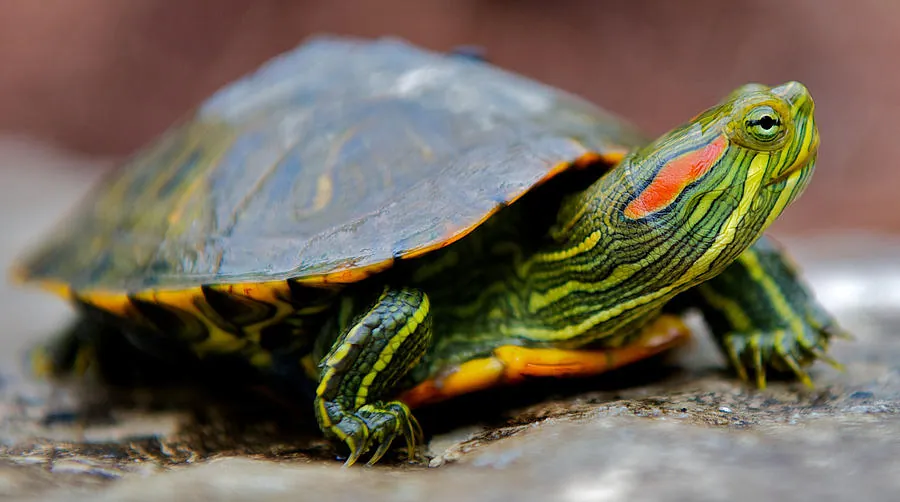
Red-Eared Slider
Trachemys scripta elegans
A semi-aquatic North American pond turtle named for the red or orange stripe behind each eye; popular in the pet trade but long-lived, messy, and space-intensive as an adult.
Overview
The red-eared slider (Trachemys scripta elegans) is a subspecies of the pond slider native to the Mississippi River basin and adjacent warm-temperate waters of the United States and northeastern Mexico. It is named for the distinctive red or orange post-orbital stripe behind each eye. Hatchlings are small and widely sold, but adults become large, heavy waste producers that need a substantial filtered aquatic setup, a dry basking dock with heat and UVB, and a multi-decade care commitment. Released pets are a major invasive-species pathway worldwide; never release a slider into outdoor waterways.
Native Regions
Mississippi River basin and Midwest United States, Gulf Coast states of the United States, Northeastern Mexico
Habitats
Ponds and lakes with still or slow water, Slow rivers, creeks, and streams, Swamps, sloughs, and vegetated freshwater wetlands, Basking sites on logs, rocks, and banks
Adult Length
Males typically about 5-8 inches carapace; females about 7-12 inches, occasionally larger
Adult Weight
Roughly 1-5.5 pounds (0.5-2.5+ kg) for many adults; large females reported up to about 7 pounds (3.2 kg)
Lifespan
20–40 years
For Beginners
Often marketed as a beginner turtle, but filtration, tank size growth, water quality, Salmonella hygiene, and a 20-40 year lifespan make it a poor first reptile for most households. Choose only if you can commit to a large adult setup from the start.
For Experienced Keepers
Experienced keepers can refine oversized indoor tanks or outdoor ponds, nitrogen-cycle management, measured UVB, quarantine, and breeding projects. Check local legality before acquiring or moving animals.
Key Points
- › Semi-aquatic, diurnal pond turtle with a red or orange stripe behind each eye
- › Needs a large filtered water volume, a fully drying basking dock, and strong UVB
- › Long-lived omnivore that shifts from protein-rich juvenile feeding to a more plant-heavy adult diet
Appearance & Behavior
A medium-sized emydid turtle with an oval, somewhat flattened carapace that is green to olive in juveniles and may darken with age. The namesake red or orange stripe sits behind each eye; skin and shell carry yellow striping that often fades in older animals. Males are usually smaller than females, with longer front claws and a longer, thicker tail. Females commonly reach about 7-12 inches carapace length; males often remain closer to 5-8 inches. Large females can weigh several kilograms.
Normal Behavior
Diurnal and strongly aquatic. Sliders swim actively, haul out to bask and fully dry the shell, and may stack on shared basking sites in the wild. They remain close to water for escape cover and forage among aquatic plants and animal prey. Captive animals often become bold around feeding routines but are not cuddly pets.
Social Behavior
Wild grouping at basking sites does not mean routine cohabitation is easy. Adult males often harass females and fight other males. Best practice is solitary housing unless the enclosure is very large, has multiple basking docks, and animals are closely monitored. Separate immediately if bullying, mounting harassment, or bite wounds appear.
Warning Signs
Lopsided floating, inability to dive, open-mouth breathing, nasal or oral bubbles, swollen or shut eyes, soft or foul-smelling shell, anorexia lasting several days, extreme lethargy, or abnormal swimming warrant husbandry review and prompt exotic veterinary care.
Key Points
- › Green to olive shell with a red or orange post-orbital stripe
- › Active daytime swimmer and dedicated basker
- › Usually best kept alone in captivity
Enclosure & Environment
Enclosure Size
Catalogue adult minimum footprint about 60 x 30 x 30 inches, sized for roughly a 10-12 inch turtle (about 5 times shell length by 3 times shell width, with water depth at least 1.5-2 times shell length). Volume rules of thumb of about 10 US gallons of water per inch of shell length put many adults near 100+ gallons; larger outdoor ponds are often better for big females.
Enclosure Type
Large glass or acrylic aquarium, stock tank, or outdoor pond with escape-proof walls; screen or open top for lighting and ventilation; never a long-term bowl or unfiltered tub for adults.
Substrate
Bare bottom is preferred for hygiene. If substrate is used, choose large smooth river rock that cannot be swallowed. Avoid fine gravel that can be ingested.
Heating
Maintain water about 75-80°F with a protected heater. Provide a dry basking surface about 90-95°F measured on the dock so the shell can dry thoroughly. Allow a modest night drop with heat lamps off while keeping water from chilling. Never use hot rocks.
Humidity
Ambient humidity is secondary to water quality for this species. Large water surfaces naturally raise enclosure humidity; prioritize filtration, partial water changes, and a fully dry basking dock over chasing a specific RH number.
Lighting
Provide a roughly 12-hour day and night cycle with bright visible light and a quality linear T5 UVB tube over the basking dock. UVB does not pass through glass or most plastics; replace bulbs on the manufacturer schedule (often every 6-12 months) even if they still glow. Target a moderate basking UVI in the open-basking emydid range (roughly UVI about 2-4 depending on source guidance) with shaded retreat available.
Décor & Enrichment
Offer a large stable basking platform, submerged hides or plants for cover, and enough swimming room to turn and dive. Live edible aquatic plants may be eaten. Secure the setup against climbing escapes.
Cleaning & Maintenance
Cycle the tank before introducing a turtle. Keep ammonia and nitrite at zero with strong filtration and weekly 20-50% partial water changes using dechlorinated water. Siphon waste; never strip-clean the entire filter media with chlorinated water. Test water regularly.
Key Points
- › Adults need a large filtered aquatic volume, not a starter kit tank
- › Dry basking dock with heat and UVB is mandatory
- › Water quality management is the core of successful care
Diet & Nutrition
Omnivorous with a clear age-related shift: juveniles need more animal protein for growth, while adults should move toward a plant-heavy diet with commercial pellets and limited protein toppers.
Food Types
Staple commercial aquatic turtle pellets; dark leafy greens and edible aquatic plants; secondary protein such as earthworms, gut-loaded insects, and occasional lean fish or shrimp. Avoid exclusive dried-shrimp diets, dog or cat food as a staple, bread, dairy, and iceberg lettuce as the only green.
Feeding Schedule
Hatchlings daily; juveniles daily or every other day with plant matter offered often; adults every 2-3 days. Remove uneaten food promptly to protect water quality.
Supplements
Provide free-choice cuttlebone. Dust protein meals with calcium more often for growing turtles and about weekly for adults with reliable UVB. Offer a multivitamin with vitamin A precursors about weekly. Do not rely on dried shrimp alone for vitamin A.
Hydration
Clean, filtered water is both the swimming medium and the drinking and feeding environment. Poor water quality quickly undermines health.
Preparation
Feed in water or a separate feeding tub to reduce fouling. Chop greens and vegetables into manageable pieces. Prefer gut-loaded insects over frequent feeder fish because of parasite and thiaminase concerns in some fish.
Common Mistakes
Keeping adults in tiny tanks, skipping UVB, overfeeding protein, feeding only pellets or only dried shrimp, never offering greens, and dumping unwanted pets into outdoor ponds.
Key Points
- › Juveniles are more carnivorous; adults need mostly plants plus pellets
- › Calcium, vitamin A, and UVB work together for shell and eye health
- › Feed only what is eaten quickly to protect water quality
Handling
Sliders can become calm around people and tolerate brief, purposeful handling for health checks or enclosure moves, but they are not lap pets and do not need frequent handling.
Techniques
Support the body securely with both hands, keep nails away from your skin, and hold the turtle over a soft surface or water. Move slowly. Wash hands thoroughly before and after contact.
Do's & Don'ts
Do minimize handling time. Do not kiss turtles, allow them on food-prep surfaces, or clean tanks in kitchen sinks. Keep young children and immunocompromised people from unsupervised contact because of Salmonella risk. Never drop or flip a turtle roughly.
Taming
Consistency around feeding and enclosure maintenance usually builds tolerance better than frequent handling sessions. Expect observation and feeding interest more than affection.
Stress Signals
Rapid withdrawal into the shell, frantic swimming or clawing, hissing, attempts to bite, or prolonged refusal to bask after handling mean interaction should stop.
Key Points
- › Brief supported handling is fine for care tasks
- › Not a high-contact pet; Salmonella hygiene is essential
- › Reduce handling if stress signs appear
Health & Wellness
Common Health Issues
Shell rot (ulcerative shell disease)
Description
Bacterial or fungal infection of the carapace or plastron, often linked to poor water quality, inadequate drying, or shell trauma.
Symptoms
Soft, pitted, foul-smelling, discolored, or flaking shell; scute lifting; pink or bloody tissue under damaged scutes; lethargy.
Prevention
Maintain excellent filtration and water quality, provide a fully drying basking dock daily, correct heat and UVB, and address injuries early.
Treatment
Contact a qualified exotic veterinarian promptly; do not rely on home remedies for deep shell infections.
Respiratory infection
Description
Common when water or basking temperatures are too low, water is dirty, or the turtle is chronically chilled.
Symptoms
Open-mouth breathing, bubbles from nose or mouth, wheezing, mucus, lopsided floating, closed eyes, anorexia, constant basking.
Prevention
Keep water and basking temperatures in range, avoid cold drafts and cold water changes, and quarantine new animals.
Treatment
Seek veterinary care early; aquatic turtle respiratory disease can progress quickly and may require prescription therapy.
Vitamin A deficiency and related eye or ear problems
Description
Nutritional disease from narrow diets, especially dried-shrimp-only feeding, leading to eye swelling and sometimes aural abscesses.
Symptoms
Swollen or shut eyes, thick discharge, bulges behind the jaw (ear abscesses), poor appetite.
Prevention
Feed varied dark leafy greens and quality pellets; do not rely on dried shrimp alone.
Treatment
Veterinary assessment is required; treatment may include husbandry correction and prescription vitamin A therapy.
Metabolic bone disease and soft or pyramided shell
Description
Calcium and vitamin D imbalance from inadequate UVB, poor diet, or insufficient calcium.
Symptoms
Soft shell, deformed or peaked scutes, weak jaw, lethargy, swollen limbs, difficulty walking or swimming straight.
Prevention
Provide measured UVB replaced on schedule, free-choice calcium, balanced diet, and proper basking temperatures.
Treatment
Contact a qualified exotic veterinarian; supportive husbandry alone is not enough for advanced cases.
Preventative Care
Annual exams with an exotic veterinarian, fecal testing when advised, routine water testing, UVB bulb replacement on schedule, and handwashing after any contact. This content is educational husbandry guidance, not a diagnosis.
Emergency Signs — seek vet care immediately
Cannot dive or floats lopsided for more than a day; soft, foul-smelling, bleeding, or deeply pitted shell; eyes swollen shut with thick discharge; open-mouth breathing or nasal bubbles; complete anorexia for several days; cloacal prolapse; sudden buoyancy change after chilling.
Key Points
- › Most problems trace to water quality, temperature, UVB, or diet
- › Shell, respiratory, eye, and metabolic issues are the common clusters
- › Use a qualified exotic veterinarian for illness and emergencies
Breeding
Oviparous freshwater turtles. Captive breeding requires mature animals, a large setup, and a terrestrial nesting area; it is a welfare-sensitive project rather than a casual add-on.
Preparation
Confirm sex and maturity, excellent body condition, and quarantine health. Provide a nesting box or land area with deep moist soil or sand mix for gravid females. Avoid breeding animals that are undersized or chronically stressed.
Breeding Process
Courtship often includes male titillation of the female's face with elongated foreclaws. Nesting is typically spring through summer, sometimes into fall depending on climate. Females dig a nest on land and may travel well away from water.
Egg Care
Incubate eggs in a moist substrate around roughly 80-85°F unless following a specific temperature-sex-determination plan. Incubation commonly lasts about 60-95 days. Cooler nests tend to produce males and warmer nests females near published thresholds around the high 20s °C.
Hatchling Care
Hatchlings need shallow but swimmable water, easy haul-outs, reliable heat and UVB, and a protein-rich diet. Some wild hatchlings overwinter in the nest; captive incubation usually aims for timely emergence under controlled conditions.
Key Points
- › Females need a moist nesting site on land
- › Clutches are modest; incubation is temperature-sensitive
- › Hatchlings require shallow aquatic setups and higher protein